10 Practice Questions for the Math Portion of the ACT

ACT math prep is essential for students looking to improve their scores and enhance their college applications. The ACT math section covers a variety of topics including algebra, geometry, trigonometry, and statistics. Effective preparation means not only practicing problems but also grasping the underlying concepts and mastering test-taking strategies. Using resources like practice questions, study guides, and prep bundles can help students identify their strengths and weaknesses. Consistent practice builds familiarity with the test format and can increase accuracy and speed. Teachers provide valuable support by offering guidance and resources to help students reach their highest potential

If you’re a teacher or a student gearing up for the math portion of the ACT, I’ve got just the thing for you—10 practice questions that mirror the ACT format with five multiple-choice options each. This set includes a mix of algebra, geometry, and probability to help gauge understanding and proficiency. An answer key is provided at the end to check the answers and see if students are on the right track. If more practice is needed, there’s a list of additional resources at the bottom of this post. Go ahead and take a look!

  1. What is the value of 3x2 – 5x + 2 when x = 2?
    A) 4
    B) 6
    C) 8
    D) 10
    E) 12
  2. In a right triangle, one angle measures 45 degrees. What is the measure of the other acute angle?
    A) 30 degrees
    B) 45 degrees
    C) 60 degrees
    D) 75 degrees
    E) 90 degrees
  3. Solve the equation: 2(x+1) = 16
    A) 2
    B) 3
    C) 4
    D) 5
    E) -2
  4. What is the area of a circle with a radius of 5 units?
    A) 15π square units
    B) 20π square units
    C) 25π square units
    D) 30π square units
    E) 35π square units
  5. Simplify the expression: √1227
    A) √23
    B) √32
    C) 23
    D) 32
    E) Not Here
  6. If f(x) = 2x2 + 3x – 5, what is the value of f(4)?
    A) 17
    B) 23
    C) 29
    D) 35
    E) 39
  7. What is the y-value for the system of equations?
    2x + 3y = 7
    4x – y = 0
    A) y = 2
    B) y = 1
    C) y = 0
    D) y = -1
    E) y = 12
  8. A box contains 5 red balls, 4 blue balls, and 3 green balls. If one ball is randomly selected, what is the probability of selecting a blue ball?
    A) 13
    B) 12
    C) 411
    D) 310
    E) 89
  9. The sum of three consecutive even integers is 42. What is the smallest of the three integers?
    A) 10
    B) 12
    C) 14
    D) 16
    E) 18
  10. A triangle has side lengths of 5 cm, 8 cm, and 10 cm. What type of triangle is it?
    A) Equiangular triangle
    B) Acute triangle
    C) Obtuse triangle
    D) Right triangle
    E) Isosceles triangle

If you would like to have a PDF copy of these questions, then I will provide the link to the resource in my store. The store copy is slightly different. Question 4 has been changed to a higher difficulty and there are three bonus questions. The resource link is the last resource on this page. Scroll to the bottom.

Here’s an answer key with explanations:

  1. To find the value of the expression, substitute x = 2 into the expression:
    3(2)2 – 5(2) + 2 = 12 – 10 + 2 = 4
    Therefore, the answer is A) 4
  2. In a right triangle, one angle is always 90 degrees. The sum of the angles in a triangle is 180 degrees. Therefore, the measure of the other acute angle would be:
    180 – 90 – 45 = 45 degrees
    Therefore, the answer is B) 45 degrees.
  3. One way of solving this equation is turn 16 into 24, then set up the following equation and solve: 2(x+1) = 24 x+1 = 4 x = 3 Another way of solving this equation is by taking the logarithm (base 2) of both sides, we get:
    (x+1)log2(2) = log2(16)
    x+1 = log2(16)
    x+1 = 4
    x = 4 – 1
    x = 3
    Therefore, the answer is B) 3.
  4. The formula to find the area of a circle is A = πr2, where r is the radius. Substituting r = 5 into the formula, we get:
    A = π(5)2 = 25π square units
    Therefore, the answer is C) 25π square units.
  5. To simplify the expression, we need to find the square root of the fraction. Simplifying the fraction first, we get:
    49
    Taking the square root of the numerator and denominator, we get:
    49 = 23
    Therefore, the answer is C) 23.
  6. To find the value of f(4), substitute x = 4 into the function:
    f(4) = 2(4)2 + 3(4) – 5 = 32 + 12 – 5 = 39
    Therefore, the answer is E) 39.
  7. To solve the system of equations for y, we can use the method of substitution or elimination. By eliminating the variable x, we can find the value of y:
    Multiply the first equation by -2:
    -4x – 6y = -14
    4x – y = 0
    Add the two equations together:
    -7y = -14
    y = 2
    Therefore, the answer is A) y = 2.
  8. The probability of selecting a blue ball can be found by dividing the number of blue balls by the total number of balls:
    Probability = Number of blue balls / Total number of balls
    Probability = 4 / (5 + 4 + 3) = 412
    Simplifying the fraction, we get:
    Probability = 13
    Therefore, the answer is A) 13.
  9. Let’s assume the smallest even integer is x. The next two consecutive even integers would be x + 2 and x + 4. The sum of the three consecutive even integers is given as 42. Set up an equation:
    x + (x + 2) + (x + 4) = 42
    3x + 6 = 42
    3x = 36
    x = 12
    Therefore, the answer is B) 12
  10. Use Pythagorean Theorem to classify the triangle. If a2 + b2 = c2, then the triangle is a right triangle. If a2 + b2 > c2, then the triangle is an acute triangle. If a2 + b2 < c2, then the triangle is an obtuse triangle.
    52 = 25, 82 = 64 and 102 = 100
    25 + 64 < 100 or 89 < 100
    Therefore, the answer is C) Obtuse Triangle

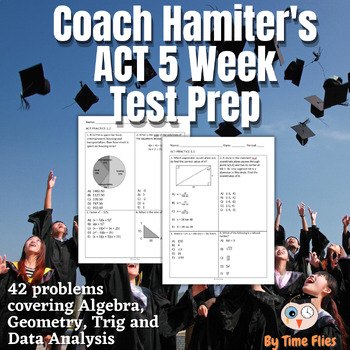
Here’s a BONUS Question for Trig Practice that I grabbed out of my ACT 5 Week Test Prep:
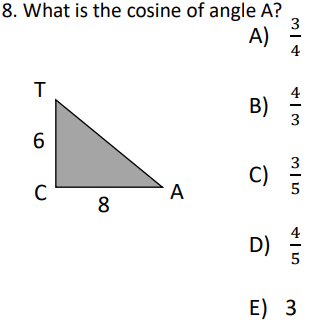
Students should remember SOH CAH TOA in order to tackle this problem. If the question asks for cosine, then look adjacent to A, which is 8, and then look at the hypotenuse, which does not have a measurement. Since TA needs a measurement, use the Pythagorean Theorem to find that the answer. 62 + 82 = TA2. Square the 6 and 8 then add them to get 100. The square root of 100 = 10, so TA = 10. Now, Cos(A) would be 810 and would reduce to 45, which is answer choice D.

I hope these practice questions prove helpful. Consistent practice is key to improving skills and boosting confidence for the ACT. For additional resources, check out the links provided. Good luck on preparing!

All these individual resources are part of the ACT Math Success Prep Bundle. Whether you need to focus on specific objectives or want comprehensive practice, I’ve got your covered.
Texas Success Initiative Assessment in Math 2.0

The new version of the Texas Success Initiative comes out in January. As far as the math goes, there is nothing new on the test. Students will still get a 20 question test, but if they don’t score high enough on that part, they get a second chance to pass it during the diagnostic portion.

If you want to know more about the test, the best place to go is to the Texas Higher Education Coordinating Board. This site is full of information. The specific TSI part is hard to find, so click here and you’ll go right to it.

Why should high school English and math teachers be interested in this? Students must pass the TSIA to take college English and math classes. This includes dual credit math and English classes. The only way students do not have to take the TSIA is if they score high on the SAT or ACT before they are starting their college-level classes.

The math portion covers 4 main areas:

  • Quantitative Reasoning
  • Algebraic Reasoning
  • Geometric and Spatial Reasoning
  • Probabilistic and Statistical Reasoning

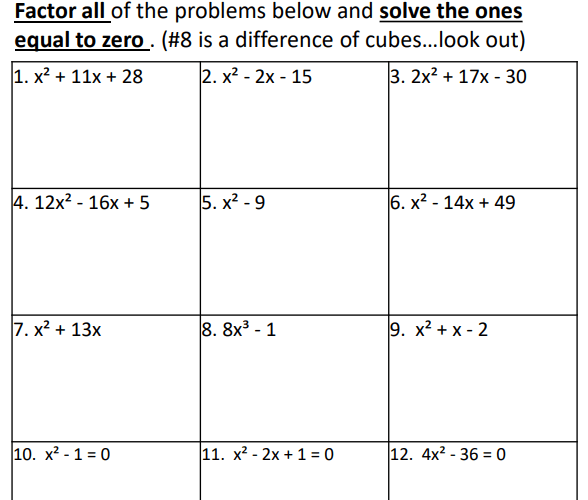
I’ve created 6 practice sheets that mimic the College Ready portion of the test which is the 20 question test. Each practice sheet has 20 questions. The first 6 cover quantitative reasoning, the next 7 cover algebraic reasoning, the next 3 over geometric and spatial reasoning and the last 4 cover probabilistic and statistical reasoning. If your students struggle on any part of them, then I have other TSI resources that will help them further.

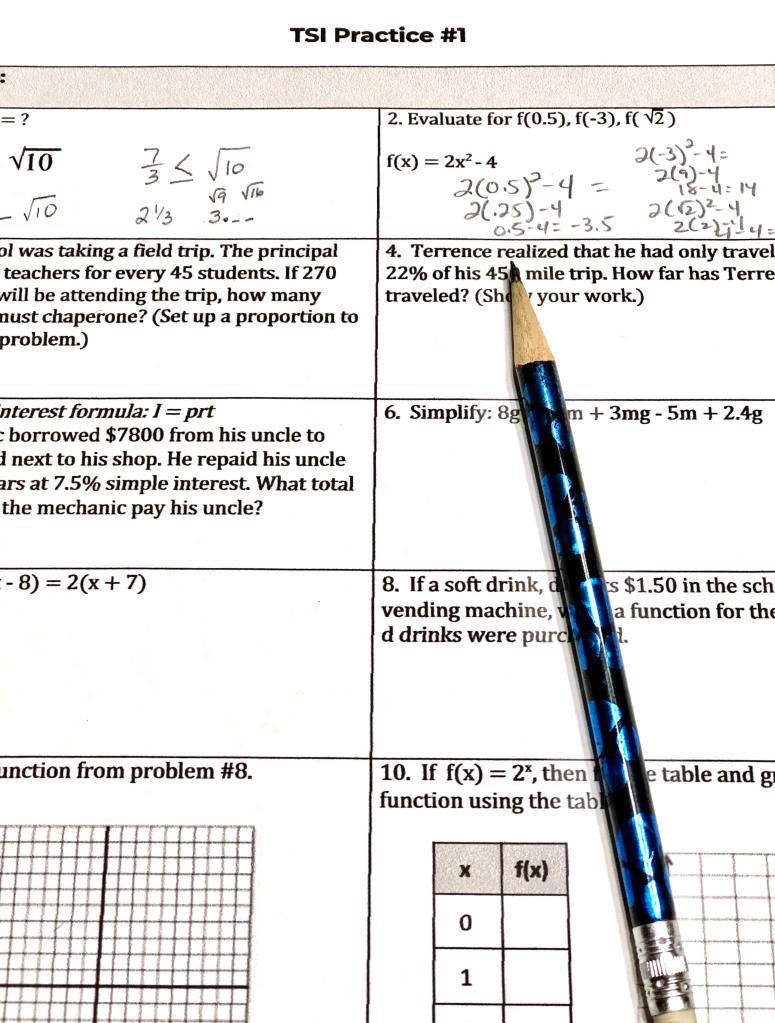
Here’s a pic of one of the sheets:

If you are not a Texas teacher and just need some good overall reviews for your ACCUPLACER class or your junior or senior math classes, these practice sheets would come in handy!

Go check this resource out or if you are interested in getting all the TSI materials, then check out the bundle!

ACT and SAT Test Dates and Math Portion Breakdown

High School teachers and their students should be aware of the ins and outs of both the SAT and ACT exams. Both of these exams are used by colleges and universities to make admission decisions. My goal as a high school math teacher is to be aware of the testing dates and keep my students practicing the skills needed to be successful on either or both of these tests. Here are the testing dates for both exams during the 2025 – 2026 testing season:

SAT ACT
Aug 23
Sept 13Sept 6
Oct 4Oct 14 (Paper Test in School)
Oct 14 – 24 (Window for digital in School)
Oct 1 – 31 (Window for PSAT and SAT in School)Oct 18
Nov 8Oct 28 (Paper Test in School)
Oct 28 – Nov 7 (Window for digital in School)
Dec 6Dec 13
Feb 14
March 2 – April 30 (Window for SAT in School)
Feb 24 – March 6 (Window for digital in School)
March 14March 10 or 24 (Paper Test in School)
All of March through April 3 (Window for digital in School)
April 11
May 2April 7 or 21 (In School)
April 7 through May 1 (Window for digital in School)
June 6June 13
July 11
Admissions Testing for 2025-2026 Season

Not all schools offer campus exams.

Here’s a free PDF of the test date schedule: SAT and ACT Testing Dates.

When a student asks me which one they should take, I always say both. Some students do much better on one of them than the other. The students should also think about which colleges they are applying to and look at the requirements to help them decide which test to take. More urban high schools are paying for students to take the tests during the school day. This is an awesome opportunity and the students should take advantage. Another thing for teachers to keep in mind is that 11th grade students have an opportunity for recognition and scholarships through the National Merit Scholarship if they do well on the PSAT in October.

If you’re wondering how the SAT and ACT math portions compare, take a look at my chart below:

SAT (2024+)
Digital SAT
ACT (2025+)
Enhanced ACT
1 Math Section with 2 Modules
• 35 min per module (70 min total)
• 44 questions total
• Module 2 adjusts based on Module 1 performance
Calculator allowed on all questions.
1 Math Section
• 50 minutes
• 45 questions
Calculator allowed on entire section.
~75% multiple choice
~25% student-produced response (gridded)
100% multiple choice
4 answer choices per question
1) Algebra (~30–35%)
• Linear equations in one or two variables
• Linear functions
• Systems of linear equations
• Linear inequalities
2) Problem Solving & Data Analysis (~30–35%)
• Ratios, rates, units, percentages
• One- and two-variable data
• Probability, statistics, and evaluating claims
3) Advanced Math (~11–16%)
• Equivalent expressions
• Nonlinear equations and functions
• Systems of nonlinear equations
4) Geometry & Trigonometry (~11–16%)
• Area and volume
• Angles and triangles
• Right triangle trig
• Circles
1. Preparing for Higher Math (57–60%)
Includes:
Number & Quantity – Real & complex numbers, exponents, vectors, matrices
Algebra – Linear, polynomial, radical, and exponential equations; systems of equations
Functions – Graphs, notation, piecewise, logarithmic, transformations
Geometry – Congruence, similarity, trig, volume, circles
Statistics & Probability – Data displays, center/spread, probability
2. Integrating Essential Skills (40–43%)
Multi-step and applied problems using:
• Percentages, rates, proportional relationships
• Area, volume, surface area
• Averages and medians
• Converting between forms
• Applying skills in real-world situations
3. Modeling (cross-category)
Appears throughout the test:
• Build or interpret equations
• Use graphs/tables/functions
• Critique or revise models
Comparing the SAT and ACT Math Portions

Now that you know more about these two exams, it’s time to start thinking about how to prepare your students. Even 9th and 10th graders can take the SAT 8/9 and the SAT 10 if your school chooses to facilitate it. All levels of students need practice over these exams. These tests are not like what students are accustomed to. One of the best ways for a teacher to understand how questions are asked is to take some practice tests. Very quickly you’ll see how you need to up your game in your classes and ask questions in different ways.

In 2016, I became a teacher on an Early College High School Campus. This is when my interest in college readiness soared. I also felt bad that in my previous years I did not give much thought about these tests. During that first year on the ECHC campus, I was given a class of seniors that had never passed the TSI (comparable to the ACCUPLACER). I had no resources, so I started researching and soon found out that I was going to need to create my own. Once I got most of my students to pass the TSI, I began preparing them for the ACT and SAT. Again, I had to create my own lessons. I’m happy to say that I’ve got all of these resources in my Teachers Pay Teachers store. I’ve got them in various forms. You can purchase bundles or individual lessons. I’m still enjoying creating these resources and I’m adding things as I go.

I’m glad you made it here. This shows that you are invested in your students. They rely on us to use our knowledge to advance their knowledge! I wish you and your students success and a happy future. Please check out my resources if you are limited on what you have available!

Other Related Posts:

TSI – ACCUPLACER READY

Study Guides for Math Portions of College Entrance Exams and College Readiness Exams

GETTING READY FOR THE OCTOBER PSAT

Are Your Students College Ready? 5 Teacher Challenges!

Resources:

TSI – ACCUPLACER Ready

I’ve put together a set of reviews both in PDF form and Digital Form for College Readiness Assessments. The reason for creating this resource is because I started teaching at an Early College High School about 5 years ago and I had no resources for my students to prepare them. I’m in Texas, so my students take the TSI. It is very similar to the ACCUPLACER. The purpose of the test is to see if students are ready to take a college math class or a college English class, but of course I’m focused on the math portion of the test. I found that students struggled on the test and needed more help. I decided to break it into 7 parts:

Packet 1 – Pre-Algebra Skills: (43 Problems)

Packet 2 – Equations, Inequalities and Linear Functions: (35 Problems)

Packet 3 – Quadratics: (45 Problems)

Packet 4 Radicals, Roots and Exponents: (37 Problems)

Packet 5 – Geometry Skills: (45 Problems)

Packet 6 – More Geometry: (24 Problems)

Packet 7 – Probability and Statistics: (25 Problems)

All 7 Packets come in a bundle AND I’ve started creating a distance learning version in a Google Sheets format. I’m over halfway finished with this bundle. This bundle also includes some Google Forms quizzes that cover each of the packets. These quizzes come separately too so they can be purchased with the PDF versions as well.