Easy-to-Use SAT Math Practice Sheets for Teachers and Students

Did you know that the average SAT math score is barely above 500 the past few years? Preparing for the SAT Math Test can feel overwhelming for both students and teachers. With so much content to cover, finding resources that are comprehensive, easy to use, and effective is essential. That’s why I’ve created my SAT Math Practice Sets—a collection of worksheets designed to target the key areas tested on the SAT. These practice sheets are a powerful tool for students preparing for test day and for teachers looking to build confidence and skills in their classrooms.

What Are the SAT Math Practice Sets?

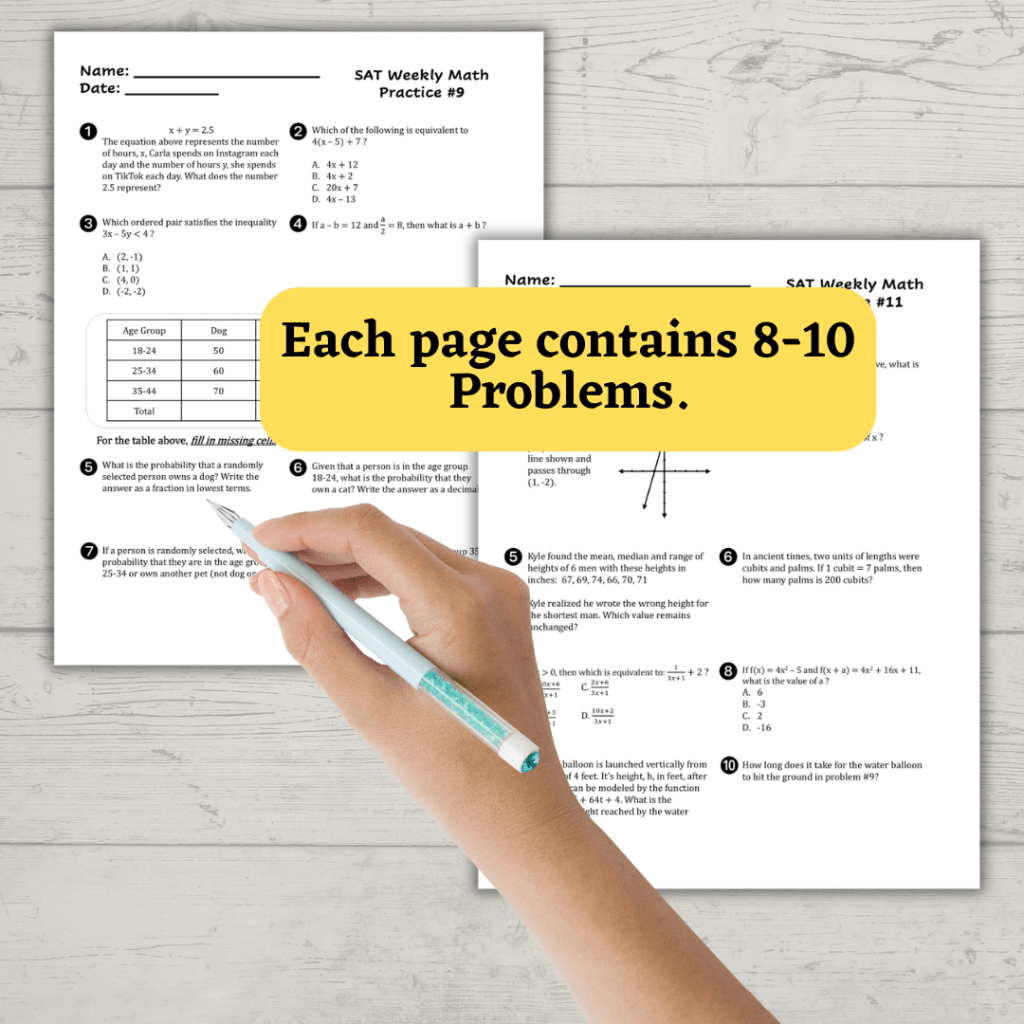
Each SAT Math Practice Set contains six worksheets with carefully curated problems that align with the four categories tested on the SAT Math section:

  • Algebra: Linear equations, systems of equations, and quadratic functions.
  • Advanced Math: Polynomials, rational expressions, and nonlinear systems.
  • Problem Solving & Data Analysis: Data interpretation, probability, and real-world applications.
  • Geometry & Trigonometry: Triangles, circles, volume, and trigonometric ratios.

The problems range in difficulty, from basic to advanced, mimicking the progression of questions students will face on the test. Each worksheet includes a mix of multiple-choice and free-response questions to provide a well-rounded practice experience.

What Makes These Practice Sets Special?
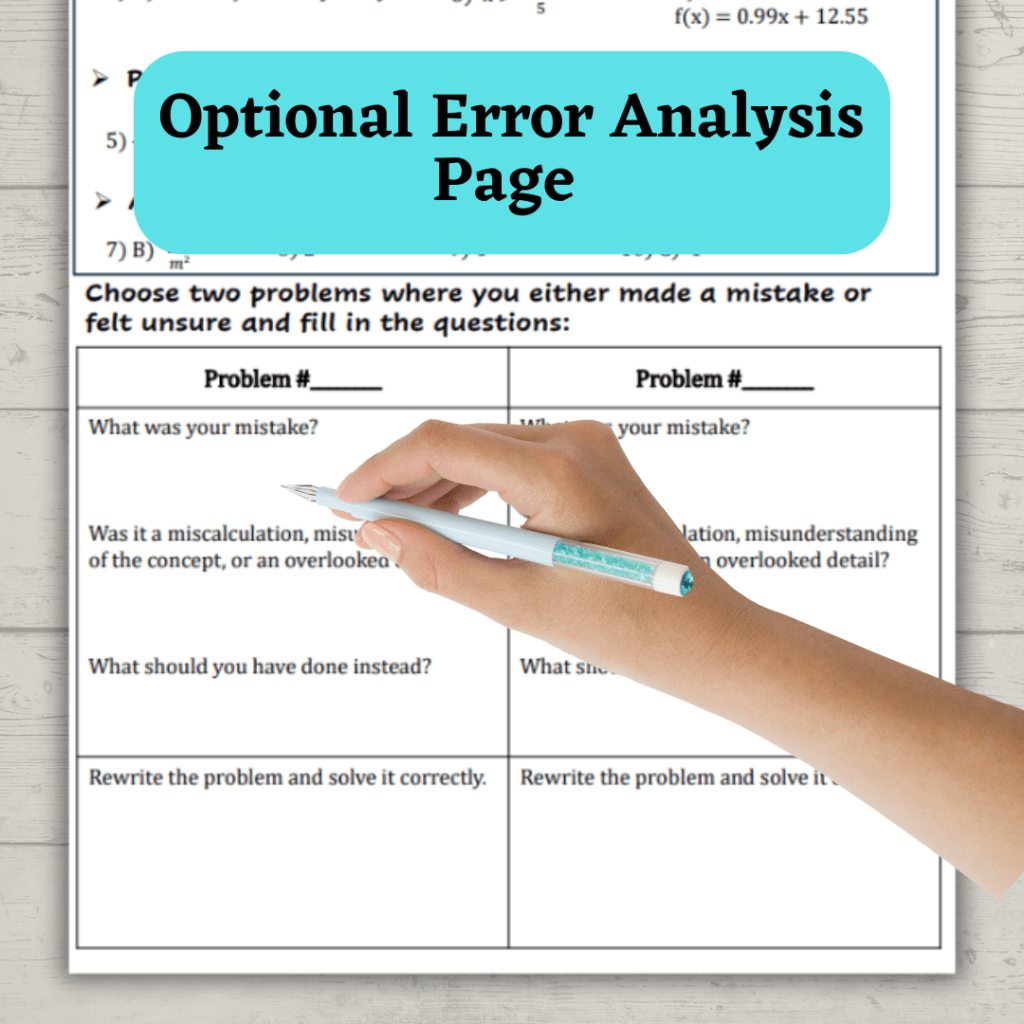
  1. Detailed Answer Keys: Each set includes step-by-step solutions for every question. This helps students learn from their mistakes and ensures teachers can easily guide their students through challenging problems.
  2. Error Analysis: Students are encouraged to reflect on their errors, identify patterns in their mistakes, and learn strategies to avoid them in the future.
  3. Test-Like Practice: The questions are formatted and styled after real SAT questions, so students can familiarize themselves with the test’s structure.
  4. Progressive Difficulty: Each worksheet increases in difficulty, helping students build confidence as they master foundational skills and tackle more advanced concepts.

How to Use These Practice Sets

Here are a few ways you can use the SAT Math Practice Sets in your classroom or at home:
  1. Daily Warm-Ups: Start each class with a few problems to get students thinking critically and practicing consistently.
  2. Weekly Homework: Assign one worksheet per week to keep students on track with their SAT prep.
  3. Group Activities: Have students work in small groups to solve problems and present their solutions to the class.
  4. Tutoring Sessions: Use these sheets during SAT prep sessions to target specific areas where students need improvement.
  5. Self-Paced Practice: Encourage students to work through the sheets at their own pace, using the answer keys and error analysis sections to guide their learning.

Why SAT Math Practice Matters

Success on the SAT Math Test isn’t just about knowing formulas and equations. It’s about developing problem-solving skills, understanding how to approach different question types, and managing time effectively. These practice sets are designed to help students build those skills while giving teachers an easy-to-implement resource to support their instruction. Here are the sets that I’ve made so far: SET 1 and SET 2.

What’s Next?

I’m working on additional practice sets to expand the collection. My goal is to provide even more targeted practice for specific topics and introduce new question formats to align with the digital SAT. Stay tuned for updates and new resources!

Whether you’re a teacher helping students prepare for college entrance exams or a student working toward your best score, these SAT Math Practice Sets are here to make the journey easier and more effective. Check them out today and see the difference they can make in your SAT prep!

Have questions or suggestions? Drop them in the comments below—I’d love to hear how you’re using these resources in your classroom or at home!

ACT and SAT Test Dates and Math Portion Breakdown

High School teachers and their students should be aware of the ins and outs of both the SAT and ACT exams. Both of these exams are used by colleges and universities to make admission decisions. My goal as a high school math teacher is to be aware of the testing dates and keep my students practicing the skills needed to be successful on either or both of these tests. Here are the testing dates for both exams during the 2026 – 2027 testing season:

MonthSATACT
August 2026August 22___
September 2026September 12September 19
October 2026October 3October 17
November 2026November 7___
December 2026December 5December 12
February 2027___February 27
March 2027March 6___
April 2027___April 10
May 2027May 1___
June 2027June 5June 12
July 2027___July 10

In-School Testing
SAT and ACT in-school testing dates vary by participating school or district. Check with your school counselor for the test dates and options available at your school.

Here’s a free PDF of the test date schedule: SAT and ACT Testing Dates.

When a student asks me which one they should take, I always say both. Some students do much better on one of them than the other. The students should also think about which colleges they are applying to and look at the requirements to help them decide which test to take. More urban high schools are paying for students to take the tests during the school day. This is an awesome opportunity and the students should take advantage. Another thing for teachers to keep in mind is that 11th grade students have an opportunity for recognition and scholarships through the National Merit Scholarship if they do well on the PSAT in October.

If you’re wondering how the SAT and ACT math portions compare, take a look at my chart below:

SAT (2024+)
Digital SAT
ACT (2025+)
Enhanced ACT
1 Math Section with 2 Modules
• 35 min per module (70 min total)
• 44 questions total
• Module 2 adjusts based on Module 1 performance
Calculator allowed on all questions.
1 Math Section
• 50 minutes
• 45 questions
Calculator allowed on entire section.
~75% multiple choice
~25% student-produced response (gridded)
100% multiple choice
4 answer choices per question
1) Algebra (~30–35%)
• Linear equations in one or two variables
• Linear functions
• Systems of linear equations
• Linear inequalities
2) Problem Solving & Data Analysis (~30–35%)
• Ratios, rates, units, percentages
• One- and two-variable data
• Probability, statistics, and evaluating claims
3) Advanced Math (~11–16%)
• Equivalent expressions
• Nonlinear equations and functions
• Systems of nonlinear equations
4) Geometry & Trigonometry (~11–16%)
• Area and volume
• Angles and triangles
• Right triangle trig
• Circles
1. Preparing for Higher Math (57–60%)
Includes:
Number & Quantity – Real & complex numbers, exponents, vectors, matrices
Algebra – Linear, polynomial, radical, and exponential equations; systems of equations
Functions – Graphs, notation, piecewise, logarithmic, transformations
Geometry – Congruence, similarity, trig, volume, circles
Statistics & Probability – Data displays, center/spread, probability
2. Integrating Essential Skills (40–43%)
Multi-step and applied problems using:
• Percentages, rates, proportional relationships
• Area, volume, surface area
• Averages and medians
• Converting between forms
• Applying skills in real-world situations
3. Modeling (cross-category)
Appears throughout the test:
• Build or interpret equations
• Use graphs/tables/functions
• Critique or revise models
Comparing the SAT and ACT Math Portions

Now that you know more about these two exams, it’s time to start thinking about how to prepare your students. Even 9th and 10th graders can take the SAT 8/9 and the SAT 10 if your school chooses to facilitate it. All levels of students need practice over these exams. These tests are not like what students are accustomed to. One of the best ways for a teacher to understand how questions are asked is to take some practice tests. Very quickly you’ll see how you need to up your game in your classes and ask questions in different ways.

In 2016, I became a teacher on an Early College High School Campus. This is when my interest in college readiness soared. I also felt bad that in my previous years I did not give much thought about these tests. During that first year on the ECHC campus, I was given a class of seniors that had never passed the TSI (comparable to the ACCUPLACER). I had no resources, so I started researching and soon found out that I was going to need to create my own. Once I got most of my students to pass the TSI, I began preparing them for the ACT and SAT. Again, I had to create my own lessons. I’m happy to say that I’ve got all of these resources in my Teachers Pay Teachers store. I’ve got them in various forms. You can purchase bundles or individual lessons. I’m still enjoying creating these resources and I’m adding things as I go.

I’m glad you made it here. This shows that you are invested in your students. They rely on us to use our knowledge to advance their knowledge! I wish you and your students success and a happy future. Please check out my resources if you are limited on what you have available!

Other Related Posts:

TSI – ACCUPLACER READY

Study Guides for Math Portions of College Entrance Exams and College Readiness Exams

GETTING READY FOR THE OCTOBER PSAT

Are Your Students College Ready? 5 Teacher Challenges!

Resources: