What Unfolds in Your Math Class When the Bell Rings?

The bell to start class just rang. Now what? Let’s talk about those classroom openers that go by many names – “bell ringers”, “warm ups”, or “do nows”. After over 35 years in the teaching game, I’ve had my fair share of experiences with these little classroom kickstarters. You could say that bell ringers (or your preferred name) and I have a bit of a “frenemy” relationship. Why? Let me elaborate on the advantages and challenges I’ve experienced with bell ringers throughout my career.

As we head into a new school year, I’ve been thinking about what still works — and what needs a refresh. Bell ringers are one of those things that can either work for you or they can be a challenge. It’s important to know how to use them properly and to realize the purpose.

The Value of Bell Ringers

First things first, let’s acknowledge the credit bell ringers deserve. They can truly elevate your teaching game. Once seamlessly integrated into your daily flow, most students will fall in line. When students enter the room, they dive straight into the bell ringer activity. This gives you some precious moments to tackle all those initial tasks that need attention – like attendance, catching up with absentees, and the never-ending quest for missing assignments.

Wondering how to make this streamlined approach a reality? It’s all about setting the groundwork from day one. Here’s the deal: let your students know that the next time they walk into the classroom, there will be a bell ringer or directions on the board waiting for them, and they should start on it right away. Consistency is key here – when you establish this routine early on, students will come to expect it and know exactly what’s coming their way.

But that’s not all. Having them dive into the bell ringer gets their gears turning. It’s like flipping a switch that says, “Time to learn, folks!” The activity itself helps reel in their focus, and guess what? It prevents those precious minutes from vanishing into thin air. Trust me, math teachers know how to squeeze every ounce of learning time from the clock.

What adds to the charm of bell ringers is their versatility. They can serve specific purposes within your lesson plan. Whether reviewing a topic, accessing material that might otherwise be overlooked, or even acting as a captivating lesson hook – a purpose-driven bell ringer provides valuable insights to educators while aiding students’ comprehension of topics and sparking their interest.

I often used bell ringers to prepare students for upcoming exams such as in-school ACT, SAT, or state tests. Additionally, I found value in conducting reviews of past topics and addressing areas where I knew many students have learning gaps.

Let’s Talk Challenges Now

It’s important to know that bell ringers don’t always go as planned. One big issue is treating them as just something to pass the time. If students think they’re not important, they might not take them seriously. Have you ever had a student ask, “Does this count for a grade?” That’s their way of saying, “I’ll only do it if it matters.” So, the trick is to make sure they have a clear purpose. Even if grades aren’t involved, helping students understand how the bell ringer helps their learning is key. It is also important that students know that once they are finished with the bell ringer, there’s a good chance that someone in the room will have to explain how to work the problem or even go to the board and work it. If students feel like they might get called on, they will not want to get caught off guard.

There were times when I was in a pinch and had to create a bell ringer on the fly, without much preparation. It’s no secret that students can sense when things are a bit disorganized. You see, the whole “Fake it until you make it” idea doesn’t work well in teaching. You can’t pretend to be organized. With a classroom full of around 28 students, there’s just too much happening. You’ve got to be on your A-game. Teaching requires real organization and being genuinely ready for what’s ahead. So, take it from someone who’s been through it – staying organized is a true game-changer and that applies to having a prepared bell ringer.

There have been times when I decided to stop doing bell ringers altogether, or at least in some classes. During remote learning, my bell ringers didn’t translate well online, so I paused them for a while. The important thing is, it’s okay to change things up when needed.

Transitioning from one activity to another can make or break the classroom atmosphere. There were years when after the bell ringer, things got a bit crazy until I could get things back on track. Realizing the importance of fewer disruptions in certain classes, I chose to skip bell ringers to stay focused and keep my sanity intact. By the way, transitions can be smooth. If you give clear directions on what to do next and even set a timer, they can go better.

The biggest reason that I have a love-hate relationship with bell ringers is the significant time investment required to either source or craft them. It can feel counterintuitive to dedicate an hour to creating something that’s intended to occupy just around 10 minutes or less of valuable class time.

Purpose Matters

If you’re set on doing bell ringers, give them a purpose. Before going any further on your quest for bell ringers, stop and write the purpose the bell ringer will serve. Here are some suggestions:

  • It will be a hook for the lesson.
  • It will be a digital task.
  • It will be a review of the previous day.
  • It will be state testing review.
  • It will be college readiness review.
  • It will be spiral review.
  • It will be a writing task.
  • It will be a seasonal math task.

Once you lock in that purpose, you can hunt down the material. You need to think about how much time you want to spend on the bell ringer in class. That will help determine how many questions you want to have. I’ve listed some ways to come up with the problems:

  • Search real-life examples so the problems have meaning.
  • Use Desmos activities and spread them out over a week.
  • Write questions that are similar to the homework.
  • Use released test questions from your state tests or from college entrance exams.
  • Grab problems out of the math book at the end of units for spiral reviews.
  • Use AI generated questions. Beware! AI is not always great with math.

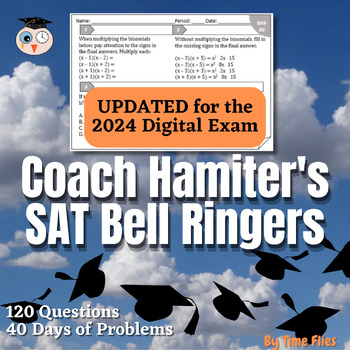
Now that you know your purpose and where your material is coming from, what format do you want to use? I’ve done different things, but one of my favorites is a three question approach where the first two questions scaffold for the third question. I’ve used this format in my ACT Bell Ringers as well as my SAT Bell Ringers. Day 26 from the SAT Bell Ringers is seen below:

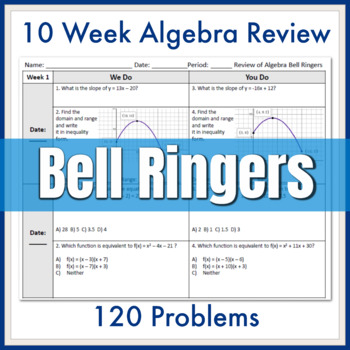
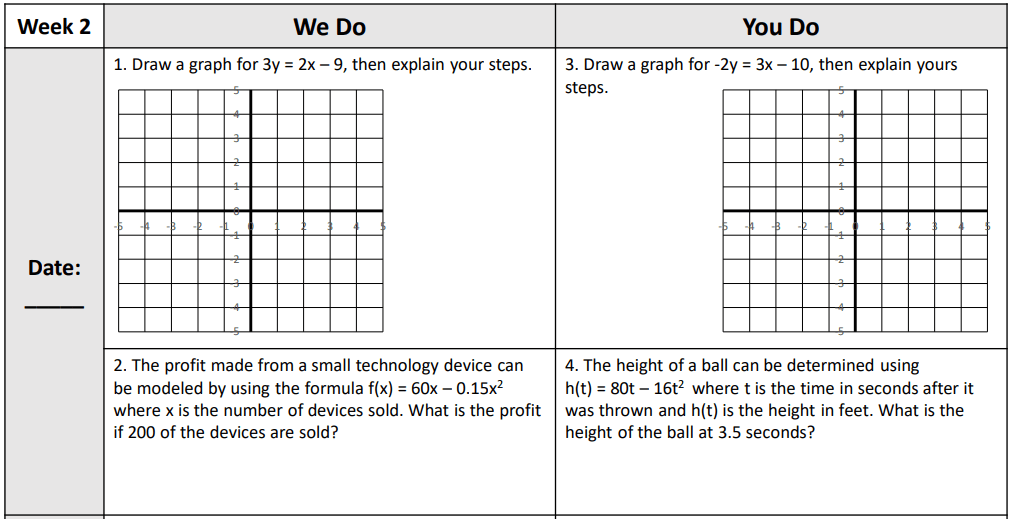
Another option is “We Do, You Do”. Together with the class, the teacher works through 1 and 2 and then lets the students work by themselves on 3 and 4. In this format, the teacher will begin class working the problems. When students work the other two, she can go do her attendance and other tasks. This approach is good when you have students that have a hard time starting. The example below is from my Algebra Review Bell Ringers.
Recently, I’ve been developing a new style of bell ringers designed with differentiation in mind. Instead of every student working through the same set of problems, this format allows students to choose from multiple levels of challenge based on their confidence and readiness that day.

This approach keeps all learners engaged—whether they need a little extra support or are ready to stretch their thinking. It also builds student independence, since they’re making decisions about how to approach the task. These differentiated bell ringers aren’t uploaded just yet, but they’re on the way. I’m excited to share them soon!

Your Bell Ringer Investment

Most of us do not want to spend our precious teacher planning period on bell ringers, so we end up working on it at home. If you decide to create these bell ringers yourself, then by all means save them so you have them for the next year. Make your time investment work for you in the future.

If you decide that recreating the wheel is not for you, then you can look at what I have. I’ve bundled up my most-used bell ringers from over the years to save others some prep time. Whether it’s Geometry, Algebra, or even a sprinkle of Trig, there’s plenty of things to choose from. Check out the resource after the final paragraph. You can look at the individual items and purchase them separately too.

In closing, the journey with bell ringers is an exploration of balancing their benefits and challenges. As educators, we adapt and refine our approach, always seeking the best ways to engage our students. Whether you’re harnessing the power of purpose-driven bell ringers, navigating their quirks, or even deciding to take a break when necessary, remember that your dedication to creating a meaningful learning experience remains at the heart of it all. With purpose as your guide, you’re well on your way to transforming those initial moments into impactful stepping stones towards an enriched classroom experience. Keep up the incredible work, and keep those bell ringers ringing with purpose!

15 End-of-Year Ideas to Keep Your Math Students Engaged

The end of the year is fast approaching and you’re probably wondering what you can do in your secondary math class to make the most of the time left. Here are some suggestions. See what will fit your situation!

  1. The obvious thing to do is review. You’ve covered a lot of topics throughout the year, so take some time to go over key concepts and formulas. Throw in some practice problems, games, technology, and hands-on activities to reinforce what has been learned. Reviewing is boring, so as you read down this list, use some of these strategies in your reviews.
  2.  Another idea is to assign a project that allows students to apply what they’ve learned to a real-world problem. This would be a great way to see math in action and flex their problem-solving muscles. An example would be to have students model real-world phenomena, such as population growth or temperature changes, using algebraic functions. This project would require students to apply their knowledge of function notation and graphing to real-world scenarios.
  3.  You will probably be giving exams, so another thing to talk about is test-taking strategies. Discuss how to read and interpret word problems, how to show work, and how to avoid common mistakes. Practicing these skills would be beneficial to show students how the strategy works. Teach your students how to make a brain dump. This is especially helpful for state exams.
  4.  Create a fun and engaging math competition for students to participate in. This can be a great way to end the year on a high note and showcase students’ math skills.
  5.  Offer individualized feedback to students on their performance throughout the year. This can help them identify areas for improvement and develop a growth mindset. If you have over 100 students, this could be a daunting task. Ask students to self-reflect first, then you could quickly add a statement or two and comment on what they felt were their strengths and weaknesses.
  6.  Recognize students who have excelled or improved in math throughout the year. This can be done through awards, certificates, or other forms of recognition. It’s also fun to give silly awards since, at this point in the year, you know the students so well.
  7.  Encourage students to set goals for themselves and create a plan to achieve them over the summer or in the next school year. It is a great skill to learn how to set goals. The great thing is that you don’t have to look at them. Have students type the goals in the notes on their phones and then encourage them to occasionally look at them to see their progress. 
  8.  Reflection activities can help students process their math learning and prepare them for future math classes. Some ideas are surveys, class discussions, journaling, writing a letter to their future self, and creating a portfolio with some of their best work.
  9.  Choose a math-themed movie or documentary to watch in class and use it as a springboard for discussion and learning. Some great options include “Hidden Figures”, “A Beautiful Mind”, “October Sky”, and “The Story of Maths”.
  10.  Create or have your students create math-themed board games that can be played in class. This is a great way to review key concepts while having fun with your students.
  11.  Group challenges encourage teamwork, foster critical thinking, provide a fun and engaging experience, build problem-solving skills, and promote healthy competition. Some group challenges are scavenger hunts, escape rooms, Kahoot, Quizizz, Jeopardy, debate, and so forth.
  12.  Take your students on a math-focused field trip to a museum, science center, or even a local construction site. This can help them see the practical application of math in the real world.
  13.  Bringing in a guest speaker would be a nice change and break up the monotony at the end of the year. It can inspire and motivate students, provide a different perspective, introduce new topics, build connections, and offer networking opportunities.
  14.  Peer tutoring is a great way to add something special to the end of the year in a math class. It encourages collaboration, builds confidence, reinforces learning, provides personalized learning, and promotes social skills.
  15.  Go outside if it’s feasible. Let students take their math notebooks and pencils and sit under a tree to study or take chalk outside and let students work on math problems on the sidewalk. Getting outdoors at the end of the year is a great way to refresh and rejuvenate yourself and your students!

It’s super important to plan out the end of the year for your math classes. You don’t want to bore your students with endless reviews and exams. Instead, make it fun with cool activities that connect what they learned to the real world. Personalized feedback is a must too, so get to planning and make the end of the year a blast for your students!

Here are some of my own resources that I tend to use at the end of the year:

Digital Activities in Math Should Still Require Showing Work

One challenge math teachers face using digital activities in the classroom is that students put down their pens/pencils and don’t pick them up at all while working on the assignment. How many times have you given a digital test and students do not work problems on paper? Do you notice they sit and stare at the screen and try to answer questions without the aid of working the problem out by hand? I think this is a big mistake on our part as teachers. We need to train students to show work even if they are filling out answers online.

Most math teachers require a journal or a notebook for notetaking. I believe that this is the perfect place to show work. Require students to date and title a page in their journal and work problems in an organized manner in the journal. The page can be a part of the overall grade of the assignment. Showing work will allow students to show steps, explain reasoning and they will have the ability to go back and find mistakes. A teacher only needs a quick glance to confirm the students did what they were supposed to do. Here are three things to consider:

  • If a student has hardly any work done, that is a sign that the student may not know what to do.
  • If students miss all the problems and don’t show work, they are clueless.
  • If students get all the problems correct and don’t show work, they may be cheating.

There is a direct correlation between the amount of work shown and how much a student understands.

For example, I use Boom Cards in my class. My students know, when working on the cards, they have a page in their journal dedicated to showing work on the assignment. I allow students to work the boom cards as many times as they want to get the grade they want. When they show work, they are able to look back at the work and see if they can find a mistake. I haven’t tried this next part but, what if I took this a step further? Have the students highlight incorrect problem(s) and, if they find their mistake(s), they write a quick statement analyzing the mistake. How much better will the math “stick” if they analyze their own mistakes? If you’ve never used Boom Cards, click on the picture below:

The one time I would not use the journal to show work is for tests. I like to provide a colored sheet of paper for showing work on a digital test. The paper must be turned in when the test is completed. Even better is to have a piece of paper that has space for each problem. If you don’t have time to print one, then have students fold the paper in half, then in half again and then again if you need that many places for answers. When students open up the paper, it is separated into 8 boxes on the front and back if the paper has been folded three times.

I recommend taking up the paper after the test rather than have them take a picture and upload it. Here is why: students take a picture of their work to upload it. Now, they have that picture to send to whomever, like a friend in a later class.

A digital place to show work could be on a Google Jamboard. I used Jamboards alot during Covid. Students can easily open a Jamboard if they have a Gmail and use a separate slide for each problem. The Jamboard only comes with 20 slides, so think about this before having them use it. The Jamboard can also be shared with whomever so, be sure they put their name on it.

Example of a Jamboard

As math teachers, we tend to make a big deal about getting the right answer, but just as important as a correct answer is HOW to get the answer. If we constantly use digital activities in our classes and we are never looking at student work, then we have no clue if students really understand what they are doing. Looking at the work does not have to be time-consuming. You can quickly know if the work is legitimate or gibberish. You can catch cheaters by requiring work as well.

If we get away from having students show work, we are doing them a disservice. Our job as math teachers is to create problem solvers. It is hard to solve problems without going through steps or explaining how the solution is derived. Let’s change the way students think about digital activities and train them to show their work.

7 Reasons to use Bell Ringers in High School Math Classes

I’ve used bell ringers (sometimes called Do Nows or Warm-ups) my entire teaching career until the pandemic. For over a year, I quit using them. I was juggling too much to add bell ringers to the mix, but I’m happy to say that I’m using them again. I debated over whether to start using them because I do have a few cons that bother me.

One of my cons for using bell ringers is that it requires a transition from one task to another and sometimes transitions in a classroom are hard to deal with. Another con is that you have to think of what you want your bell ringer to be and that requires time which we as teachers have very little time.

The pros far outweigh the cons when it comes to bell ringers. I have 7 reasons why I feel like bell ringers are worth the struggle. It makes sense to me to continue using them because of what bell ringers provide.

  • #1 – Get the students busy from the start! As a teacher, the beginning of class is a chaotic time. We need to get the students settled and do attendance. If students are in a routine to come into the class and get started on the bell ringer, then the chaos is limited and the teacher has time to get organized.
  • #2 – Use bell ringers to recycle information or to review information. Maybe you want to review the first grading period during the second grading period using bell ringers. I’ve learned that 3 or 4 problems is the limit. A quick way to create something is to use material that you were not able to use during the first grading period. You might have run out of time to do a worksheet or maybe you did not get to go as deep as you wanted. Divide that worksheet into days and give it to your students at the beginning of the week. Students get the worksheet out at the start of class each day and work on it. (I have my students tape everything into their journal so they do not lose it.)
  • #3 – Use bell ringers as a quick check to find out what students know. For instance, before a lesson on the properties of exponents, you decide to see if students remember how to use integer operations or if they remember that 5^3 really means 5*5*5. Before any lesson, think about what might cause some issues. Do not assume that students remember their math from past grades. Give them some problems and see what they remember. This will guide you to take a moment to reteach some concepts before you get started.
  • #4 – Bell ringers can simply be a way to get your students thinking or “get the wheels turning” as they say. Some teachers call bell ringers warm ups. That’s a good name! Before you run, don’t you warm up. You want to get the blood flowing and the muscles stretched. The brain is no different. It’s great to have students focused and thinking before you begin a lesson.
  • #5 – This reason is related to #4 above… Use bell ringers as a lesson opener. To get the “wheels turning” use a problem to spark interest in the topic you are about to teach. Real-life problems are a great thing to use. It really doesn’t have to be anything but a picture or a simple question. For instance, before a quadratic lesson you could have a picture of a football player throwing a pass. You could ask students to predict if the throw is accurate or how many yards the ball will travel. The great thing about this kind of question is that anyone can answer it. All kids are on an equal playing field. All students can be successful on these types of questions.
  • #6 – Here’s a biggie… Use bell ringers to fill in gaps. Welp, we all know how important that is at this time. Think about the students you teach. What’s missing in their learning. What did they NOT learn the past few years that you can practice through bell ringers? You could literally pull material from the previous grade level and reteach it. If your state has standardized testing, go pull from old tests. You could even go back a couple of grade levels. Think of the good this would do!
  • #7 – Use bell ringers to prepare students for standardized tests. Not all math teachers think about preparing students for college entrance exams or college placement exams. Your students will be taking tests such as the ACT, SAT, PSAT, TSI or ACCUPLACER. Why not give them a taste of what they will see on these tests? Students are not familiar with the questioning used on these types of tests. What a great service you would be doing for your students if you helped prepare them for what they might see on college entrance exams.

I hope I’ve given you some ideas. To me, bell ringers are another learning opportunity. To provide the best thing for your students, you need to think about your particular groups. My Algebra students need something different than my Geometry students most of the time. The only time that I may give them the same bell ringers is if I’m in the mode of preparing them for the TSI or PSAT.

My biggest concern for my Geometry students is how much Algebra they lost last year. I created an Algebra bell ringer resource just for them. When I’m doing these bell ringers with them, I’ll ask them to raise their hand if they remember certain things. It’s terribly disappointing how little they learned last year. I’ll link this resource below if you are interested, but here is a freebie related to those bell ringers. Each day there are four problems. I work two with them and then they do two on their own.

Your next question might be, should you grade bell ringers? I usually grade on completion. I have students keep the bell ringers in their journals, so sometimes during a journal check, I might refer back to certain bell ringers and ask them questions about them.

I’ve attached some of my bell ringers below that are in my TpT store. Half the battle is having time to create them. Remember, bell ringers do not have to be something you create. It can be an old worksheet that you didn’t get to or it can be review material that you have. I’ve used my TSI material a lot as bell ringers. I’ll pull a page out of a lesson and it will become my bell ringers for the week. The great thing about TSI or ACCUPLACER material is that it covers a variety of content that students should know from past math classes.

Here’s what I’m currently using with my Geometry Classes:

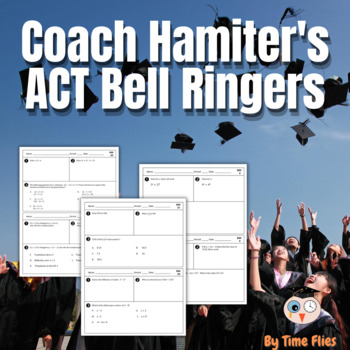
These next two resources are for college entrance exams:

I use any of my TSI resources to pull from for various reasons. I recently pulled from this activity for my Algebra class bell ringers to help recycle previous concepts:

I have all of my bell ringers including in one bundle so you can save:

If you like my ideas and tips, then consider joining my email list. If you chose to do that, then you will receive a free exponential function hands-on activity. Join Now!

Good luck with your bell ringers. If you are not on board, I understand. I have my reservations at times too. You need to do what is best for your situation.

Please follow me at my TpT Store so that you know when I upload new resources. All my new resources are 50% off for 24 hours.