Small Group Quizzes in Math

I love small group quizzes for so many reasons! Its a win win situation. I cannot say enough about this type of strategy. I’ve done group quizzes for many years, but with the help of my peers, I’ve figured out the way that works best for me. I’ve also discovered that it will evolve the more you do it. You’ll get an idea to try something new or you’ll stop doing something else that’s not working the way you want.

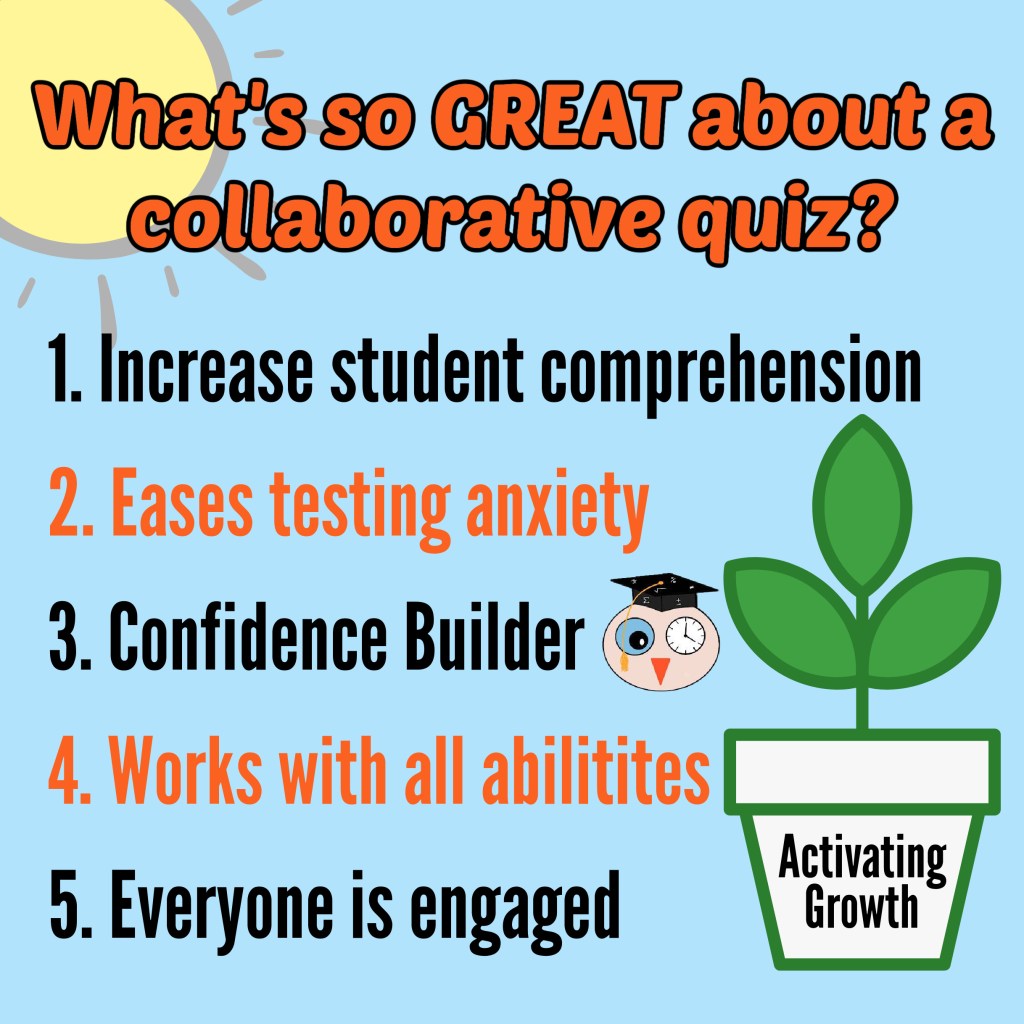
What are group quizzes? Group quizzes are collaborative quizzes that give students a chance to deepen their learning through discussions. Imagine awesome engagement and conversations. Imagine all levels of abilities working together and activating growth. THAT’s what happens during a well constructed small group quiz.

I have 2 ways of doing these quizzes:

  1. Students are put into groups of 4. Each student will receive their own version of the quiz. Yes, this means you need at least 4 versions of the same quiz. Students work together through discussions to complete their own quiz. THE DISCUSSIONS ARE AMAZING! I do not allow students to grab each other’s papers and copy straight from them. That is a big no no…(so you do have to walk around a bit, but I can still get so much done while the kids are working together it’s not even funny.)
  2. Students are put into groups of  3, 4 or 5. All students in the group have the same quiz. Assign each student a letter or a number. They write that letter or number beside their name in INK!  The students work together to complete the quiz. (Again, they cannot grab someone’s paper and copy it.) At the end of the allotted time, the teacher will spin a spinner, roll some dice or use some sort of number or letter picker to decide whose paper will be the one graded for the group. The person that is selected will put their paper on top of the group pile with everyone else’s paper below. The quizzes are paperclipped and turned in. I usually grade the top paper only, but I’ll flip through the pile to make sure everyone was successful. I tell the students ahead of time what will happen at the end of the time. Throughout the quiz I give reminders to not allow anyone to sit and do nothing since their paper might be the one graded for the group. A little peer pressure is ok. I don’t allow anyone to be mean, but I’ve never found that to be the case. If I see that someone actually could hurt the group, then I’ll do something creative so that person doesn’t cause any issues.

If you’ve never tried a group quiz or think that your students are too rowdy for this, then think again. Try it! You will need to put some thought into your groups ahead of time. I like to make sure that I have some high abilities with some strugglers. I try to put some quiet people with the loud people. I never let them pick their own groups. I do not ever put all strugglers together or all high abilities together. I usually go by grades in the gradebook and then I think about who gets along. I use my name plates (we make these at the beginning of the year and it is mentioned in the post: 1st Week of Math Class Ideas) to put people in their groups. I will not let kids enter the room until I’ve place the names plates on the desks.

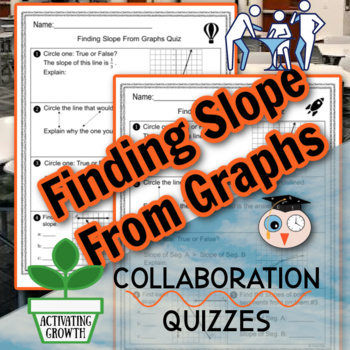
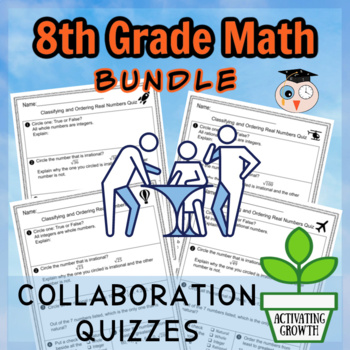
Hopefully, I have you motivated to try this strategy. If you need some quizzes to use, I have started creating some. I will be making more throughout the year, so please check often. Each set has 4 versions of the same quiz, so you can use either of my two strategies that I mention above. If you will follow me on Teachers Pay Teachers, you will know when I upload new resources. They are always 50% off for 24 hours.
Disclaimer: This site contains affiliate links in which I will get a commission if you decide to buy something using the link I provided.

Give Your Students Hope on a Math Test

Semester finals are coming! Of course you will review and try to prepare your students, but time is limited. How can you help your students do better and still keep your standards high?

USE   AN   ANSWER   BANK.

If you have a 20 question test and you have 20 answers in an answer bank, your test is still challenging but you are giving your students hope which means they will put more effort into trying! That’s what we want, right? EFFORT! 

Will some students guess by using the answer bank? Absolutely! When I give an answer bank, I have two rules:

  • Students have to keep the test for a certain amount of time before turning it in.
  • Students have to show work on all of the problems. 

Try it this year. I think that you will be pleasantly surprised. If students feel like they have an advantage, it makes a big difference in their attitude. Please let me know how this goes for you.

I have two final assessments with answer banks if you would like to try them. (My Algebra 1 Final with an Answer Bank is in the works. Be on the lookout for it soon!)

Finals with answers banks are below:

7 Reasons to use Bell Ringers in High School Math Classes

I’ve used bell ringers (sometimes called Do Nows or Warm-ups) my entire teaching career until the pandemic. For over a year, I quit using them. I was juggling too much to add bell ringers to the mix, but I’m happy to say that I’m using them again. I debated over whether to start using them because I do have a few cons that bother me.

One of my cons for using bell ringers is that it requires a transition from one task to another and sometimes transitions in a classroom are hard to deal with. Another con is that you have to think of what you want your bell ringer to be and that requires time which we as teachers have very little time.

The pros far outweigh the cons when it comes to bell ringers. I have 7 reasons why I feel like bell ringers are worth the struggle. It makes sense to me to continue using them because of what bell ringers provide.

  • #1 – Get the students busy from the start! As a teacher, the beginning of class is a chaotic time. We need to get the students settled and do attendance. If students are in a routine to come into the class and get started on the bell ringer, then the chaos is limited and the teacher has time to get organized.
  • #2 – Use bell ringers to recycle information or to review information. Maybe you want to review the first grading period during the second grading period using bell ringers. I’ve learned that 3 or 4 problems is the limit. A quick way to create something is to use material that you were not able to use during the first grading period. You might have run out of time to do a worksheet or maybe you did not get to go as deep as you wanted. Divide that worksheet into days and give it to your students at the beginning of the week. Students get the worksheet out at the start of class each day and work on it. (I have my students tape everything into their journal so they do not lose it.)
  • #3 – Use bell ringers as a quick check to find out what students know. For instance, before a lesson on the properties of exponents, you decide to see if students remember how to use integer operations or if they remember that 5^3 really means 5*5*5. Before any lesson, think about what might cause some issues. Do not assume that students remember their math from past grades. Give them some problems and see what they remember. This will guide you to take a moment to reteach some concepts before you get started.
  • #4 – Bell ringers can simply be a way to get your students thinking or “get the wheels turning” as they say. Some teachers call bell ringers warm ups. That’s a good name! Before you run, don’t you warm up. You want to get the blood flowing and the muscles stretched. The brain is no different. It’s great to have students focused and thinking before you begin a lesson.
  • #5 – This reason is related to #4 above… Use bell ringers as a lesson opener. To get the “wheels turning” use a problem to spark interest in the topic you are about to teach. Real-life problems are a great thing to use. It really doesn’t have to be anything but a picture or a simple question. For instance, before a quadratic lesson you could have a picture of a football player throwing a pass. You could ask students to predict if the throw is accurate or how many yards the ball will travel. The great thing about this kind of question is that anyone can answer it. All kids are on an equal playing field. All students can be successful on these types of questions.
  • #6 – Here’s a biggie… Use bell ringers to fill in gaps. Welp, we all know how important that is at this time. Think about the students you teach. What’s missing in their learning. What did they NOT learn the past few years that you can practice through bell ringers? You could literally pull material from the previous grade level and reteach it. If your state has standardized testing, go pull from old tests. You could even go back a couple of grade levels. Think of the good this would do!
  • #7 – Use bell ringers to prepare students for standardized tests. Not all math teachers think about preparing students for college entrance exams or college placement exams. Your students will be taking tests such as the ACT, SAT, PSAT, TSI or ACCUPLACER. Why not give them a taste of what they will see on these tests? Students are not familiar with the questioning used on these types of tests. What a great service you would be doing for your students if you helped prepare them for what they might see on college entrance exams.

I hope I’ve given you some ideas. To me, bell ringers are another learning opportunity. To provide the best thing for your students, you need to think about your particular groups. My Algebra students need something different than my Geometry students most of the time. The only time that I may give them the same bell ringers is if I’m in the mode of preparing them for the TSI or PSAT.

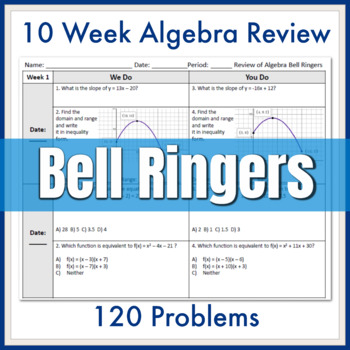
My biggest concern for my Geometry students is how much Algebra they lost last year. I created an Algebra bell ringer resource just for them. When I’m doing these bell ringers with them, I’ll ask them to raise their hand if they remember certain things. It’s terribly disappointing how little they learned last year. I’ll link this resource below if you are interested, but here is a freebie related to those bell ringers. Each day there are four problems. I work two with them and then they do two on their own.

Your next question might be, should you grade bell ringers? I usually grade on completion. I have students keep the bell ringers in their journals, so sometimes during a journal check, I might refer back to certain bell ringers and ask them questions about them.

I’ve attached some of my bell ringers below that are in my TpT store. Half the battle is having time to create them. Remember, bell ringers do not have to be something you create. It can be an old worksheet that you didn’t get to or it can be review material that you have. I’ve used my TSI material a lot as bell ringers. I’ll pull a page out of a lesson and it will become my bell ringers for the week. The great thing about TSI or ACCUPLACER material is that it covers a variety of content that students should know from past math classes.

Here’s what I’m currently using with my Geometry Classes:

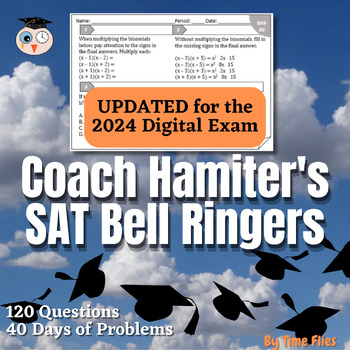
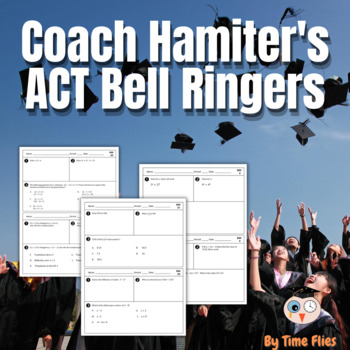
These next two resources are for college entrance exams:

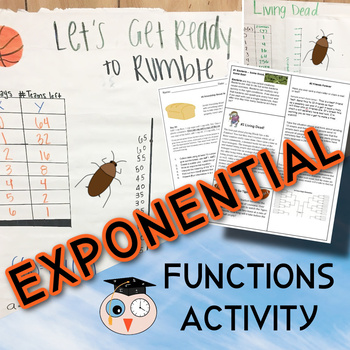
I use any of my TSI resources to pull from for various reasons. I recently pulled from this activity for my Algebra class bell ringers to help recycle previous concepts:

I have all of my bell ringers including in one bundle so you can save:

If you like my ideas and tips, then consider joining my email list. If you chose to do that, then you will receive a free exponential function hands-on activity. Join Now!

Good luck with your bell ringers. If you are not on board, I understand. I have my reservations at times too. You need to do what is best for your situation.

Please follow me at my TpT Store so that you know when I upload new resources. All my new resources are 50% off for 24 hours.

Real-Life Exponential Functions

Exponential functions are right around the corner for my math classes. I always look forward to this time of year. The best part about exponential functions is the real-life aspect. Students are more interested if they can make a connection. Draw your students in and they will enjoy this topic without realizing how much they are learning.

One of the first real-life examples that I can think of right now, is COVID-19. Remember when the saying was, “Flatten the curve?” What an interesting thing to talk about with students. A flatter curve means what? A steeper curve means what? What a great thing to talk about!

Here’s a great research letter I found on the CDC website. This has some wonderful references to “doubling time”. The research brings in some formulas and if you look at some of the appendices, it gets pretty technical, but it is fascinating.

The Coronavirus is a topic that I’m sure will get the attention of your students. Another topic that students may not be as familiar, but it is definitely worth mentioning is the stock market. Let your students read this article from Forbes. They may not think the stock market is very exciting, but after reading this article, it might spark some students to consider how they can one day invest in stocks.

A really fun exponential growth activities is the paper folding activity. I’m sure most math teachers have used this when teaching exponential functions. I love that Myth Busters tried to fold a giant piece of paper to see how many times they could fold it. Check out this video below:

We’ve been focused on exponential growth, but what about decay? Carbon dating is a topic that is also fascinating. This article can help students and teachers alike to understand carbon dating a little better: What is Carbon Dating? This might help students understand how scientist can estimate the age of an object. Below is a nice video that explains carbon 14 and half-life.

If you’ve read my blog before, you know how much I love exponential functions. I’m always on the lookout to learn more and find interesting things for my students to do. Below, you’ll find some of my resources that I sell on Teachers Pay Teachers. I’ve got all kinds of exponential function activities to keep your students busy and interested. Go take a look and I hope that you will want to follow my store and join my email list!