30 Ways to Say “Show Your Work” (Without Saying “Show Your Work”)

If you’ve ever told a student to show their work and been met with blank stares, scribbled-down numbers, or complete avoidance, you’re not alone. The truth is, many students don’t actually know what show your work means—or why it matters. To them, it sounds like just another rule, a hoop to jump through. But what if we reframed it?

The key is helping students see that showing their work isn’t about writing things down just because we said so—IT’S ABOUT MAKING THEIR THINKING VISIBLE! It’s about leaving a trail so they can check their reasoning, catch mistakes, and explain their process. And sometimes, the phrase show your work just doesn’t connect.

So, let’s rethink the way we ask students to document their thinking. Here are 30 different ways to say ‘show your work’ that might resonate more with your students:

Process-Oriented Phrases

  1. Document your thinking.
  2. Make mathematical notes.
  3. Write down your thought process.
  4. Track your steps.
  5. Show how you figured it out.
  6. Record your strategy.
  7. Map out your solution.
  8. Make your thinking visible.
  9. Break it down step by step.
  10. Illustrate your reasoning.

Student-Centered Language

  1. Convince me your answer makes sense.
  2. Tell the story of how you solved it.
  3. What would you write to teach someone else?
  4. Create a roadmap for your brain.
  5. Explain your approach in a way a friend would understand.
  6. Help me see what’s going on in your head.
  7. Write it in a way future-you will understand when you check your work.
  8. If you got stuck, what steps did you take before that?
  9. How can you prove your answer is correct?
  10. Would someone else be able to follow your thinking?

Visual/Creative Approaches

  1. Sketch your solution.
  2. Draw a diagram to support your answer.
  3. Use arrows or highlights to show key steps.
  4. Make a quick explainer box.
  5. Write a one-minute summary of what you did.
  6. Turn it into a “math comic strip.”
  7. Use colors to separate different parts of your thinking.
  8. Write a math journal entry about this problem.
  9. Make a checklist of the steps you took.
  10. Explain it in a way you’d post on social media (but keep it math-related!).

Why This Matters

When students hear show your work, they often think we’re asking for a long, tedious process that just slows them down. But when we shift the language to focus on thinking, reasoning, and problem-solving, it becomes more meaningful.

Try using some of these alternative phrases in your classroom and see how your students respond. You might just find that showing their work becomes something they actually understand—and maybe even value.

What are your favorite ways to get students to document their thinking? Do you like any of the ones above? Share in the comments!

Bell ringers are a great place to have students demonstrate they know how to show work or make their reasoning visible. The bundle below has 144 days-worth of bell work problems. Click on the resource to see more details.

Points of Concurrency: Connecting Geometry & Algebra

As educators, we’re always juggling – trying to cover a mountain of curriculum while making sure our students really understand the core concepts. And sometimes, we stumble upon those topics that make us wonder, “Is this really essential?” Points of concurrency and special segments in triangles often fall into this category. They can seem a bit intimidating, and let’s face it, we’re often pressed for time. So, should we teach them? Skim them? Skip them entirely?

Let’s explore this geometric puzzle, considering curriculum needs, the value of these concepts, and some practical strategies for teaching them effectively.

Why These Concepts Matter

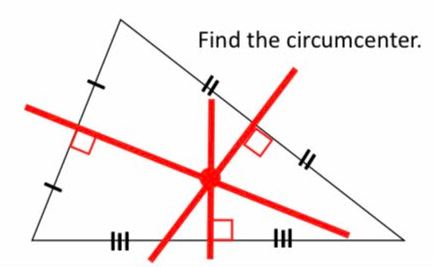
Points of concurrency (like the centroid, incenter, circumcenter, and orthocenter) and their related segments (medians, angle bisectors, perpendicular bisectors, and altitudes) are more than just geometric trivia. They deepen students’ understanding of triangles and provide a fantastic opportunity to reinforce essential algebra and coordinate geometry skills.

Think about it: Finding midpoints to construct medians? That’s a direct link to the midpoint formula! Exploring perpendicular bisectors? Hello, slope and linear equations! These connections help students see the bigger picture of math, where different concepts intertwine and support each other.

To Teach or Not to Teach…That is the Question!

Of course, before diving in, it’s crucial to check your state’s curriculum requirements. Texas educators, you’re in luck – these topics are explicitly included in your standards. But that’s not the case everywhere. Even if these concepts aren’t mandated, incorporating them (even in a simplified way) can enrich your students’ geometric understanding and strengthen those all-important algebra connections.

Time-Saving Strategies for Busy Teachers

Okay, let’s be real. We’re all short on time. If you’re feeling the curriculum crunch, here’s how to approach these concepts efficiently:

  • Keep it concise: Focus on definitions, basic constructions, key properties, and simple applications. No need to get lost in the weeds!
  • Link it to algebra: Highlight those connections to the midpoint formula, slope, etc. – it’s built-in review!
  • Get hands-on: Ditch the lengthy lectures and opt for interactive activities. Dynamic geometry software like GeoGebra or Desmos is your friend!

Quick Activity Ideas:

  • Software exploration: Let students construct triangles and explore those points of concurrency virtually.
  • “Find the Center” challenge: Give clues about a specific point of concurrency and have students play detective.
  • Real-world connections: Briefly touch on how these concepts are used in architecture or engineering.

By keeping it focused and engaging, you can make these concepts accessible even with limited time.

Beyond Geometry: Expanding the Horizons

Here’s the cool thing about points of concurrency and special segments: they can bridge the gap between different math topics. Imagine your Algebra 2 students revisiting systems of equations through the lens of triangle properties. Or your geometry students solidifying their coordinate geometry skills. It’s all about making connections and deepening understanding.

Ready for a Deep Dive?

While simplifying is helpful, sometimes you want to go deeper. If you’re looking for a comprehensive and engaging resource, check out “Points of Concurrency Lesson and Project.” This resource provides hands-on activities, real-world applications, and a chance to reinforce those crucial algebra skills. It’s a fantastic way to provide a more in-depth and enriching learning experience.

Wrapping It Up

Whether you simplify, integrate, or (occasionally) skip, remember that a well-rounded mathematical education is key. Points of concurrency and special segments, while sometimes overlooked, offer valuable learning opportunities. By approaching them thoughtfully, you can equip your students with the skills they need to succeed in their mathematical journeys.extend beyond the classroom.

10 Practice Questions for the Math Portion of the ACT

ACT math prep is essential for students looking to improve their scores and enhance their college applications. The ACT math section covers a variety of topics including algebra, geometry, trigonometry, and statistics. Effective preparation means not only practicing problems but also grasping the underlying concepts and mastering test-taking strategies. Using resources like practice questions, study guides, and prep bundles can help students identify their strengths and weaknesses. Consistent practice builds familiarity with the test format and can increase accuracy and speed. Teachers provide valuable support by offering guidance and resources to help students reach their highest potential

If you’re a teacher or a student gearing up for the math portion of the ACT, I’ve got just the thing for you—10 practice questions that mirror the ACT format with five multiple-choice options each. This set includes a mix of algebra, geometry, and probability to help gauge understanding and proficiency. An answer key is provided at the end to check the answers and see if students are on the right track. If more practice is needed, there’s a list of additional resources at the bottom of this post. Go ahead and take a look!

  1. What is the value of 3x2 – 5x + 2 when x = 2?
    A) 4
    B) 6
    C) 8
    D) 10
    E) 12
  2. In a right triangle, one angle measures 45 degrees. What is the measure of the other acute angle?
    A) 30 degrees
    B) 45 degrees
    C) 60 degrees
    D) 75 degrees
    E) 90 degrees
  3. Solve the equation: 2(x+1) = 16
    A) 2
    B) 3
    C) 4
    D) 5
    E) -2
  4. What is the area of a circle with a radius of 5 units?
    A) 15π square units
    B) 20π square units
    C) 25π square units
    D) 30π square units
    E) 35π square units
  5. Simplify the expression: √1227
    A) √23
    B) √32
    C) 23
    D) 32
    E) Not Here
  6. If f(x) = 2x2 + 3x – 5, what is the value of f(4)?
    A) 17
    B) 23
    C) 29
    D) 35
    E) 39
  7. What is the y-value for the system of equations?
    2x + 3y = 7
    4x – y = 0
    A) y = 2
    B) y = 1
    C) y = 0
    D) y = -1
    E) y = 12
  8. A box contains 5 red balls, 4 blue balls, and 3 green balls. If one ball is randomly selected, what is the probability of selecting a blue ball?
    A) 13
    B) 12
    C) 411
    D) 310
    E) 89
  9. The sum of three consecutive even integers is 42. What is the smallest of the three integers?
    A) 10
    B) 12
    C) 14
    D) 16
    E) 18
  10. A triangle has side lengths of 5 cm, 8 cm, and 10 cm. What type of triangle is it?
    A) Equiangular triangle
    B) Acute triangle
    C) Obtuse triangle
    D) Right triangle
    E) Isosceles triangle

If you would like to have a PDF copy of these questions, then I will provide the link to the resource in my store. The store copy is slightly different. Question 4 has been changed to a higher difficulty and there are three bonus questions. The resource link is the last resource on this page. Scroll to the bottom.

Here’s an answer key with explanations:

  1. To find the value of the expression, substitute x = 2 into the expression:
    3(2)2 – 5(2) + 2 = 12 – 10 + 2 = 4
    Therefore, the answer is A) 4
  2. In a right triangle, one angle is always 90 degrees. The sum of the angles in a triangle is 180 degrees. Therefore, the measure of the other acute angle would be:
    180 – 90 – 45 = 45 degrees
    Therefore, the answer is B) 45 degrees.
  3. One way of solving this equation is turn 16 into 24, then set up the following equation and solve: 2(x+1) = 24 x+1 = 4 x = 3 Another way of solving this equation is by taking the logarithm (base 2) of both sides, we get:
    (x+1)log2(2) = log2(16)
    x+1 = log2(16)
    x+1 = 4
    x = 4 – 1
    x = 3
    Therefore, the answer is B) 3.
  4. The formula to find the area of a circle is A = πr2, where r is the radius. Substituting r = 5 into the formula, we get:
    A = π(5)2 = 25π square units
    Therefore, the answer is C) 25π square units.
  5. To simplify the expression, we need to find the square root of the fraction. Simplifying the fraction first, we get:
    49
    Taking the square root of the numerator and denominator, we get:
    49 = 23
    Therefore, the answer is C) 23.
  6. To find the value of f(4), substitute x = 4 into the function:
    f(4) = 2(4)2 + 3(4) – 5 = 32 + 12 – 5 = 39
    Therefore, the answer is E) 39.
  7. To solve the system of equations for y, we can use the method of substitution or elimination. By eliminating the variable x, we can find the value of y:
    Multiply the first equation by -2:
    -4x – 6y = -14
    4x – y = 0
    Add the two equations together:
    -7y = -14
    y = 2
    Therefore, the answer is A) y = 2.
  8. The probability of selecting a blue ball can be found by dividing the number of blue balls by the total number of balls:
    Probability = Number of blue balls / Total number of balls
    Probability = 4 / (5 + 4 + 3) = 412
    Simplifying the fraction, we get:
    Probability = 13
    Therefore, the answer is A) 13.
  9. Let’s assume the smallest even integer is x. The next two consecutive even integers would be x + 2 and x + 4. The sum of the three consecutive even integers is given as 42. Set up an equation:
    x + (x + 2) + (x + 4) = 42
    3x + 6 = 42
    3x = 36
    x = 12
    Therefore, the answer is B) 12
  10. Use Pythagorean Theorem to classify the triangle. If a2 + b2 = c2, then the triangle is a right triangle. If a2 + b2 > c2, then the triangle is an acute triangle. If a2 + b2 < c2, then the triangle is an obtuse triangle.
    52 = 25, 82 = 64 and 102 = 100
    25 + 64 < 100 or 89 < 100
    Therefore, the answer is C) Obtuse Triangle

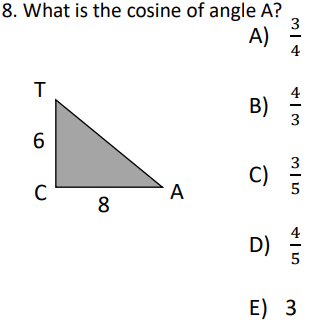
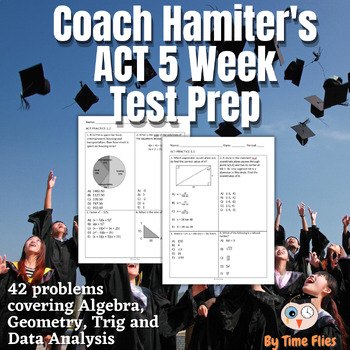
Here’s a BONUS Question for Trig Practice that I grabbed out of my ACT 5 Week Test Prep:

Students should remember SOH CAH TOA in order to tackle this problem. If the question asks for cosine, then look adjacent to A, which is 8, and then look at the hypotenuse, which does not have a measurement. Since TA needs a measurement, use the Pythagorean Theorem to find that the answer. 62 + 82 = TA2. Square the 6 and 8 then add them to get 100. The square root of 100 = 10, so TA = 10. Now, Cos(A) would be 810 and would reduce to 45, which is answer choice D.

I hope these practice questions prove helpful. Consistent practice is key to improving skills and boosting confidence for the ACT. For additional resources, check out the links provided. Good luck on preparing!

All these individual resources are part of the ACT Math Success Prep Bundle. Whether you need to focus on specific objectives or want comprehensive practice, I’ve got your covered.

Math Events and Phenomenon in 2024 For Your Secondary Classroom

In our pursuit of enhancing math education, let’s look into engaging activities that bring real-world events into your classroom. I’d like to explore some noteworthy occasions in 2024—Leap Year, Pi Day, and the Total Solar Eclipse (to name a few) — and how to seamlessly integrate them into your math lessons.

Leap Year

Leap years serve the purpose of aligning our calendar with Earth’s orbit around the sun. Picture this: a year clocks in at around 365.25 days. Without those periodic additional days, our calendar would gradually veer out of sync with the solar orbit.

Leap Year is on a Thursday so it would be a perfect time to throw in some real-life math that day. Here are three suggestions:

  • Leap Year Calculation and Discussions: (I pulled this from https://www.almanac.com/when-next-leap-year) A year may be a leap year if it is evenly divisible by 4.Years divisible by 100 (century years such as 1900 or 2000) cannot be leap years unless they are also divisible by 400. (For this reason, the years 1700, 1800, and 1900 were not leap years, but the years 1600 and 2000 were.)
  • Average Year Length: Examine the average length of a year, accounting for those crucial leap years. For example, if we take a four-year period (which includes one leap year), the average length of a year would be: (365+365+365+366) divided by 4 = 365.25 days
  • Birthday Probability: Inject some practical math by examining the probability of being born on February 29th. The chances of a baby being born on Leap Day is pretty slim: about one in 1,461, as Feb. 29 only comes around once every 1,461 days. And if a baby is born during a Leap Year, the chance of their birthday falling on Feb. 29 is a one in 366 chance (but of course, it all completely depends on when the baby was conceived).

Pi Day and More

Another event early in 2024 is Pi Day. Each year math enthusiast celebrate this event because of the numbers on the calender: 3/14, but did you know about these other celebrated, but not as well known math days?

  • “e” or Euler’s day which would be on 2/7
  • Palindrome Days which will occur in April in 2024, such as 4/2/24 or 4/21/24 etc.
  • Fibonacci Day: 11/23

My neighbor worked at Lockhead Martin for years and it was a thing to bring pie on Pi Day each year. Of course the engineers at Lockhead would think of that! People in general have embraced Pi Day, so it’s a fun event to celebrate each year.

Here is the activity that I do for Pi Day to refresh area and circumference of circles: Area and Circumference of Circles Coloring Activity

A good activity for Euler’s Day would be one where compounding continuously is explored. I have this activity called: Compound Interest Activity. In my Log Unit, there’s a section on dealing with natural logs, so that would be a nice activity as well.

I have never celebrated Palindrome Days before, but it would be really great to do that in April of 2024. Palindromes’ in general could be explored: words, phrases or numbers.

  • Examples of word palindromes: racecar, level, rotator, civic
  • Example of phrase palindromes: A Santa lived as a devil at NASA
  • Example of a palindrome math problem: 121 X 11 = 1331

Total Solar Eclipse

Now let’s discuss the Solar Eclipse that occurs on April 8, 2024 in North America. The path starts in Mazatlan Mexico, passes from Texas to Maine and into the far east of Canada. You can view the path on the NASA site here.

April 8th is a Monday. Start now and think about how you can take advantage of this phenomenon. If you love STEM activities, the sky is the limit (literally)!

If you are planning to take your students outside to see the event, you might want to start journaling about the event. My husband created an Eclipse Journal. The journal helps students explore thought-provoking questions, research tasks, and engaging activities. My husband is a biology teacher and an eclipse enthusiast.

If you aren’t the journaling type, then what can you do on April 8th? Here are some ideas:

1) If you are in the path and have permission, take your class to watch. You must take safety precaustions. Either purchase eclipse glasses, or make eclipse viewer.

2) Not in the path, but still want to watch? Here’s where to see past eclipses and future ones: Exploratorium.

3) Here’s a math challenge called Pi in the Sky from NASA. I hope you find all of this interesting. I know your plate is full, but real life events are a perfect time to show students how math can be used outside of the classroom.

Let’s gear up for a an exciting year in our classrooms. We’ve explored Leap Year, Pi Day, and the Total Solar Eclipse in 2024, but there’s another cool date in the not so distant futre… mark your calendars for a unique mathematical celebration on July 24, 2025 – Pythagorean Theorem Day! No matter where in the world you are or how you write the date, the sum of the squares of the first two digits (7 and 24) perfectly aligns with the square of the year (25). It’s an opportunity to explore the wonders of Pythagoras’ Theorem in a fun and memorable way with your students.

Here’s to a year filled with hands-on learning, real-world connections, and the joy of discovering the wonders of math in everyday life. Wishing you and your students a fantastic and mathematically enriching journey!