Posted on — Leave a comment

The Algebra STAAR Dilemma

With COVID still going strong, it’s hard to know how to prepare for the Algebra STAAR exam. Teachers are sick, students are sick, campuses are closing or going virtual. How do you deal with all of this? First, don’t put pressure on yourself. You can only do so much. You can plan and teach the students that are there. That’s it. You are an awesome teacher. Never forget that!

It’s 2022 and we are headed into the second semester of school. I’m wrapping up linear functions in a couple of weeks and I feel pretty far behind. My plan is to give myself at least three weeks before the test to review. I still need to cover exponentials and quadratics. How do I get all of this done? I like to get a calendar and put the test dates on it and mark off the three weeks of review. I look at my school calendar and make sure I know when spring break is and when the English I & II STAAR will be.

***You can get a copy of my planning calendar, so you can make it fit your needs. I’ll attach it at the bottom of this post.

Something new that I’m doing this year is focusing on the free response questions. I’ve created activities that will help students build confidence on the types of problems that they will see on the griddables or fill-in-the-blank problems. My students will take the online STAAR, so I’ve got this Boom Card Activity for them: Algebra STAAR Review Free Response Practice

If your students are taking the paper version of the test, here is the same activity in PDF form: Algebra STAAR Griddable Activity for Paper Version

Here is an outline of my plan. Remember to pick and choose what will work with your schedule!

  • End of Jan: Finish Systems
  • February: Exponent Rules, Geometric Sequences and Exponential Functions (some things in this unit you can omit).
  • Feb 28 – March 4: Algebra Task Cards (These are in the STAAR Bundle) as Bell Ringers or Opening Activity. Polynomials – Mainly multiplying binomials and refreshers on combining like terms and distributive property.
  • March 7 – 11: Continue Task Cards and Factoring
  • March 28 – April 8: Start Taking Task Card Timed Quizzes. Start quadratics using my objective 6, 7 and 8 resources from the Algebra I STAAR Bundle.
  • April 11 – 15: Continue with quadratics and do quick reviews of objectives 4 & 12 (combined these two objectives have only been 3 – 5 questions in the past)
  • April 18 – 22: Reviews of objectives 2, 3 and 9 – I’ll use my STAAR Bundle, but I will pick and choose what I want to use from these objectives. (Bell Ringers will be key features of graphs.)
  • April 25 – 29: Objectives 5, 10 and 11 – I’ll use my STAAR Bundle, but I will pick and choose what I want to use from these objectives. Bell Ringers will be Brain Dump Practice.

Here’s my calendar. Make a copy and then make it work for you!

When all is said and done, I’ll reflect and see how it went.

Please don’t stress out Algebra Teachers! Do what you can. Have a plan and work through the plan. Things will be fine. The students will do as well as they can and we will probably be pleasantly surprised at how well most of them will do. Remember that YOU ARE AWESOME!

Posted on — Leave a comment

Slope and Rate of Change

I was going through a review of slope that I made a couple of years ago. I love this resource! It was created for the 8th grade STAAR, but I feel like all Algebra teachers would love this. Students are supposed to come into Algebra with a concept of slope already! Why do students have such a hard time with it? Slope is a fun and interesting concept and of course ties to so many real-life situations. Let me tell you what this review contains:

Now remember that it is a review of slope! The first page gives the students a picture of a line with four points on the line. The students are asked to find the slope of two different segments along the same line, two different ways. The picture also has two right triangles drawn that were created from using the endpoints of the segments. Students that already have a concept of slope should be able to think of several ways to find slope. I love this so much. On top of that, shouldn’t the slopes be the same and the two triangles created are similar. Hopefully students will have that Ah-ha moment!

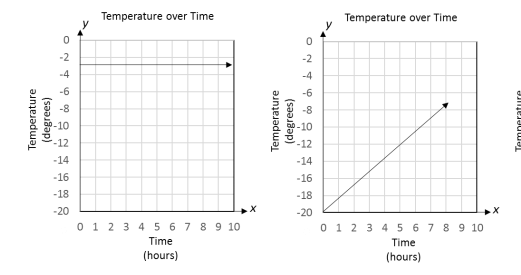
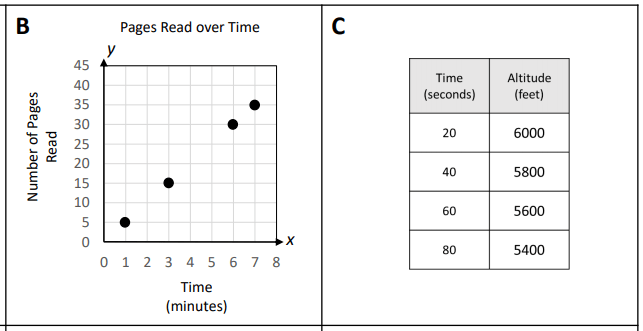
The next two pages have the students interpret the meaning of slope by matching a situation to a graph. The students are thinking of slope as a rate of change and having a proportional relationship. I love the different graphs. Teachers could ask the students to find the slopes of all of the graphs first before trying to match them to the situation. Students are asked to explain why the graphs they did not choose are incorrect. Having students explain their reasoning is always important in math.

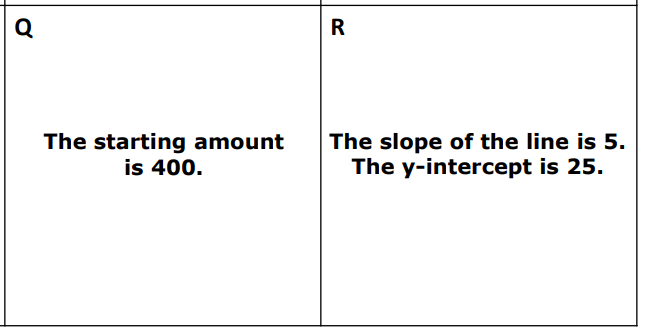
The next four pages are a set of 24 matching cards. 12 of the cards have either a graph or a table. The other 12 cards display a slope, y-intercept or another way of identifying that it matches one of the graph or table cards. This activity is engaging and students have to know what they are doing!

Finally, the last page in this resource is something that I have consistently placed in every 8th grade STAAR resource. I call it Smath’s Problem. It is an activity that reviews several of the topics in the resource. It is interesting and students enjoy working through the situation. It can be used as an assessment or a group activity.

I think you’ll enjoy this resource. All of the answer keys are included. Take a look if this sounds interesting!

Posted on — Leave a comment

Algebra STAAR Review Plan For Algebra and Geometry Teachers

***Please read further, but I recently found out that students that took Algebra and passed in the 2019-2020 school year are exempt from ever taking the STAAR test. When I wrote this, I did not know that. Here it is on the TEA website:

In waiving the required performance on academic assessments under TEC, §28.025(c) and §39.025(a) for spring 2020, the following applies: If a student is on schedule to complete instruction in the entire curriculum in spring 2020 for a course that has a corresponding STAAR EOC assessment, the student is not required to pass that specific test to fulfill graduation requirements. If a student is on schedule to complete graduation requirements in spring 2020 but does not have the opportunity to retake a STAAR EOC assessment prior to graduation, the student is not required to pass that specific test to fulfill graduation requirements but will need to complete the IGC process. For students graduating in future years but taking one of the five courses with a corresponding STAAR EOC assessment this year, those students will not be responsible for meeting that EOC assessment graduation requirement if they earn course credit this year.

This changes my thinking, but I am going to incorporate as much of the Algebra that I’ve listed below through bell ringers in Geometry since they are going to be weak. This will help them in their future math classes! At least now, I don’t have to do it all in one semester. I can spread it out over the year.

Here is this original post:

About 4 years ago, I created an Algebra STAAR Review that covered the newly established Algebra TEKS. Each of the Algebra TEKS is covered on a page of its own. At the top of each page, I put the objective practiced on that page. My thinking was if a teacher wanted to individualize the work, or just cover a certain standard in class, then this would make it easy for them.

Most people love the review, but some people complained that it was too much material. It is too much to try to cover in 2 or 3 weeks before the test. It is a detailed review with a short quiz at the end of each section. Each objective would probably take two to three (or more in some cases) 50 minute class periods to get it done. My mistake was that I did not give the teachers that purchased this review a suggested plan of action. With the craziness of school last year, I feel like it’s time to help teachers with a plan of action for the STAAR test. I have many questions from my district and the state that cannot be answered until we get closer to the school year, but I still want to forge ahead with a plan and I’d like to share it with you.

I am constantly studying the Algebra STAAR Exams. Recently, I took the tests from the last 3 years and put together an analysis. I wanted to see any patterns or trends. TEA has said how many questions come from each category, but when you figure out the details yourself, it’s eye opening. I’m going to teach all of the TEKS, but this helps me know which ones that I really need to emphasize. I took each objective and broke it into each standard within the objective and made tables and graphs for each objective. Below is the one I made for all of the objectives. The columns represent the number of questions in that category for that year.

*You can get a copy of the whole analysis at the end of this blogpost.

Before I share my plan, I wanted to discuss more about how to use the resources. For instance, Objective 2 has nine standards. There is no way to do all nine standards plus the quiz at the end right before the test if you want to review other topics. A suggestion is to use parts of the review during the school year to spiral the information. Pull them out when you need to review for a test or use them as bell ringers. Teachers have no time and before they know it the test is right around the corner. The best time to plan is as early as possible. My review bundle can be used throughout the year AND at the end of the year, so get the review now, print it off, put it in a binder and start thinking about how you can use the material. Also, if you purchase this and see something that needs to be added, just give me a shout out and I’ll see what I can do. (That’s the best part about purchasing from Teachers Pay Teachers. We can revise and edit as needed!) One thing that I really love about creating resources and lesson planning is being able to help other teachers that do not have the time to do it themselves, so here’s my Algebra STAAR TESTING PLAN for 2020-2021. I’m using the dates set by Texas as of July 2020. If things change, then I’ll adjust. I will be teaching both Algebra 1 and Geometry next year. Both groups will be taking the Algebra STAAR at some point since the STAAR testing was cancelled last school year.

EOC BEll Ringers – 10 Weeks, 120 Problems

All of the plans below are based on my Algebra STAAR Bundle and the EOC Bell Ringers-(I’ve changed the title to “Algebra Bell Ringer Review” but it is the same as previous.) The one thing not incorporated into my plan as of now are the quizzes at the end of the objectives. These could be used as pretests, posttests, homework, tutorials etc. I’m sure times will arise that I’m not thinking of right now, where I can use them.


TEST PLAN – December Test

(Testing Window – December 8 – 18, 2020)

Who is the Test For? Students that did not pass the Algebra STAAR in previous years and geometry or other math students that did not pass the Algebra STAAR or never took it because of COVID-19.

*If you see red Algebra TEKS in my descriptions below, they are readiness standards which means they are more of a focus on the test. (Go Look at the Algebra TEKS on the TEA website.)

**Note to Geometry Teachers – Let’s face it, Geometry will not be the same. You will need to focus on Algebra when you can. Some Geometry topics will not get as much attention this year!!! Some good news is that we do cover Algebra naturally in Geometry. While we are working on Parallel and Perpendicular lines, we can cover these Algebra Standards: 2B, 2E, 2F, 2G. When we are working with segments, segment addition, angles and angle addition, we can cover the solving equations standard: 5A.

  • Start the 2nd Week of Schooland do:
  • Pick days before Thanksgivingto work specifically on these topics: (***Side Note – My Algebra EOC Review covers all the TEKS and at the top of each page the objective is written, so you can easily pull the TEKS you need!)
    • Linear Topics – Writing and Graphing Equations Slope and Key Features of Graphs (2C, 3A, 3B, 3C)
    • Writing, Graphing and Solving Linear Inequalities (2H, 3D, 5B)
    • Quadratics – Writing, Graphing, Key Features, Transformations (6B, 6C, 7A, 7C)
    • Factoring and Solving Quadratics by Factoring (10E, 8A)
    • Writing and Solving Systems (2I, 3F, 5C)
  • Week of November 30:
    • Laws of Exponents (11B)
    • Exponential Functions (9B, 9C, 9D)
    • Domain and Range (2A, 6A, 9A)
    • Any other last minute details

TEST PLAN – May Test

(Testing Window – May 4 – June 4, 2021)

Who is the Test For? Students in Algebra 1 and students that did not pass the previous Algebra STAAR test.

For the Algebra I Students: (Use the Algebra Review STAAR Bundle)

  • Use these objectives as Bell Ringers OR add them to your homework/classwork starting the 2nd Semester. Each of these objectives is covered on a page in the bundle for that objective:
    • 1st Week: 2B, 2D
    • 2nd Week: 2E, 2F, 2G, 2H
    • 3rd Week: 3A, 3H
    • 4th Week: 4A, 4B, 4C
    • 5th Week: 12A, 12B, 12E
    • 6th Week: 9A, 9B, 9E,
    • 7th Week: 10A, 10B, 10C
    • 8th Week: 10D, 10E, 10F
    • 9th Week: 6A, 6B, 6C
    • 10th Week: 8A, 8B, 11B
    • 11th Week: 12C, 12D
  • End of March: (March 22, 2021)
    • The 3 Quizzes and Task Cards – (This is part of the bundle!) This takes a while to complete. I usually start the Task Cards at the end of March. Last year, I used the Task Cards as flash cards and put them in rings for each student.
  • 2 Weeks Before the Test:
    • First Week:
      • 3B, 3C, 3D, 3E
    • 2nd Week
      • 5C, 9C, 9D, 11B
  • 1/2 Day of Camp :
    • Use the worksheets and the task cards to do: 2A, 2C, 2I
    • Use the matching cards to practice: 3F, 3G, 3H
    • Use the task cards to do: 5A, 5B
    • Use the worksheets to do: 7A, 7B, 7C

For Students that did not pass in previous years or in December:

  • Invite to 1/2 Day Camp
  • Individualized Packets – Use their test results to create individualized packets.

To sum up what you will need to follow this plan:

Here’s a free sample of the Bell Ringers: Bell Ringer Sample

Posted on — 1 Comment

First 6 Weeks in Algebra 1

Algebra 1 is a fun but challenging class to teach. So many thoughts run through my head when I think about the beginning of the year in Algebra. One of the biggies is how much do the students remember from their previous math class? This is especially a big question since last year our district went to a distance learning format. I’m not sure what to expect from the incoming students, so I need a plan.

This year will be interesting. Our district has decided to have both online learning and in class learning. I’m working hard to make sure I have plenty of lessons that will work for either scenario. I’m going to start the year off with a two day review of number sense, order of operations and basic operations with integers. I’ve used this in the past because I always get a range of abilities, so I want to know where the students are. I have a print version of what I use and I’ve recently made a digital version. After I do the two day lesson, I give the students 3 quizzes (yep 3… because I want the repetition and plus it’s a challenge). All the quizzes are similar to each other but ask slightly different questions. The quizzes contain 15 questions. To move to the next quiz, students must make an 80 or better. If they don’t, they retake it. (These are timed because I don’t want the students to take too long. Either they know it or they don’t.) This can last up to 3 weeks. It’s not hard to keep up with because I take a grade on each quiz. Here’s a peek at the print version of the quiz vs. the Google Forms version:

The majority of the six weeks should (and hopefully will) be spent on solving equations. The days in the plan are block-schedule days. We have classes every other day for 80 minutes except on Fridays when the classes are only about 35 minutes. Below is plan that I will follow with the activities:

# of Days Topic
2Pre-Algebra Review – PDF Version or Digital Version
1Patterns (Boom Card Lesson)
1.5*Setting up and Solving Equations and Inequalities
1.5*Solving Equations and Inequalities
1*Literal Equations
1*Review Equations and Inequalities
My First 6 Weeks Plan

*Get all of the resources above in a bundle: Equations Bundle

I’ve linked the topics to some of my lessons and worksheets that I used in my TpT store, but as I see the need, I go find content in other places. My district uses a couple of resources that I pull from as well, but our students know how to find answers online for these assignments, so I don’t like to use them for homework.

If you’ve never used quizziz.com, you should try it. The kids really enjoy doing these. I like that the students can do them more than one time. I have the students show work in their journal. Basically it’s just a digital quiz with 4 answer choices. These are teacher-made and there are a ton to choose from on just about every topic.

One of my favorite digital resources is Boom Learning. If you like task cards, then you will love Boom Cards. Again, these cards are teacher-made. There are a variety of ways kids can answer questions. I started creating my own decks. I used two of my own creations the first six weeks. One set of Boom Cards covered patterns and how to write an expression from a pattern. The other set was for practicing solving equations and inequalities. The kids can go through them as many times as they want so they get a lot of practice and get the best grade possible. To use Boom Cards, you need a teacher account. The free account is perfectly fine, but you don’t get to see the reports. The best thing to do is to get a paid account which is only $15 – 35 dollars a year depending on which plan you choose. Make your own decks or purchase decks. There are free choices as well. Click here to go check out my store. I’m brand new at making these, but I can already tell that this will be something I work on because all of my classes love Boom Cards!

After I get used to my students and find out who has gaps in their learning, then it will be time to dive into tutoring. I will engage my students through online tutoring this year. It will be an interesting year to say the least. I know that I will need patience and I will need to be flexible. I’m ready for anything and I hope you are too. I wish you well in your new year!

Happy Teaching!

Posted on — Leave a comment

4th Grading Period in Algebra – Closer to Testing Season!

I cannot believe that the 4th grading period has come and gone already. Where does the time go? I’ve concentrated on solving systems, exponent rules and geometric sequences. We have just started the beginning of growth and decay for exponential functions. I feel like I’ve done a lot, but I was talking to a teacher today from another district that said that they are almost finished with the curriculum and they will have about 5 or six weeks to review for the STAAR test. I’ve still got to wrap up exponentials, foil, factor and get through quadratics in the 5th six weeks before I’m ready to start reviewing.

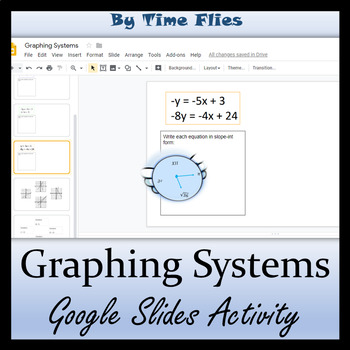
Here are some specifics about what I’ve done this grading period! Let’s start with systems. One thing about solving systems is that if you are behind in your curriculum, this is where you can catch up. You can hold off teaching your students the substitution method and the elimination method until after the test and just make sure they know how to set up systems and that they know how to solve systems on a graph or using linSolve on the nSpire calculator. I did not show them linSolve yet. I showed them how to find the intersection on the graph, but it gets complicated if students need to solve for y or if the graph’s window needs to be altered. LinSolve is a life saver and I’ll show my students how to use it before the test. I have a quick google slides activity that I like to use after I teach students how to graph systems. It also helps me to know which students are still struggling with solving for y. I have three free videos too on solving systems using various methods. These are perfect for a flipped classroom or just extra practice. The video on graphing would be great to show before doing the google slides activity! By the way, be sure to check out the new TEA calculator rules as of 2/13/2020.

I love exponent activities and I have created quite a few for my students to use. I’ve also experimented with different ways to get the students to understand the rules. The STAAR test usually has several exponent problems. I’ve seen some complicated multi-step problems. I try to get my students to understand how to find equivalent answers. I want them to know there is more than one way to write 5x^-2. I do a lot of practice with negative exponents and I work hard on the exponent of zero. I talk about how exponents are kind of like 9th graders, they don’t follow the rule of the problem. They are rebels and follow their own rules. I’ve tried PowerMan too. PowerMan is a fun way to get the students to write down the rules. See below:

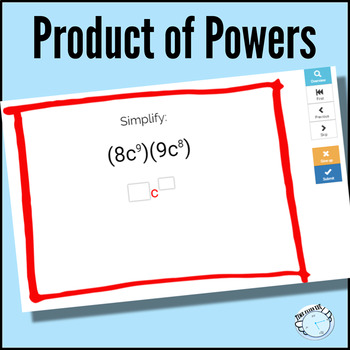
The PowerMan Explanation is at the end of my Properties of Exponents Activity in my store. I tend not to use it as the introductory method of learning exponents. Instead, I wait until I’ve taught the rules and then I’ll say, “Now, here’s how you can remember all these rules.” I get bored with worksheets, so I’ve also got a few digital exponent products. One is a google slides activity and another is just for the product property only and it is a Boom Card activity. I have a Time Flies Boom Learning Store too. If you have never heard of Boom Learning, it is worth your time to check it out!

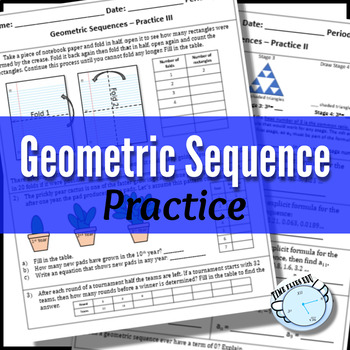
Before I really get into exponential functions, I like to introduce geometric sequences. This leads perfectly into exponentials. Students like patterns and even though the formulas are not exactly student-friendly, they usually figure out what the explicit and recursive formulas are all about. I like to do some hands-on activities too. This is my lesson that I use. It take the students through all the terminology. This is all they really need to know to be successful on the STAAR. (Which by the way, really isn’t what I’m all about, but it is part of my job to make sure they pass the test!)

My students took a benchmark created by our district this grading period. I noticed that the person that created the benchmark, took the 2019 May test and basically wrote a similar version. The first problem was a slope question and the second problem was a range question for a quadratic just like the 2019 test. I’m kind of glad they did this because I’m going to go over the benchmark and then I can use the 2019 test questions to see if the students understand their mistakes from the benchmark. If your district does not have your students take a benchmark, then I would suggest using the 2018 test as a benchmark. Divide the test up into several days and let the students take it. You can get the students to help you grade it. The TEA website has all the tests and answer keys here.

Out of 28 students, I had 20 pass the test with a 21 or better raw score. There were no surprises there. I had one person, only get 14 correct which is disturbing. She has struggled all year, but I didn’t think she was one of my lower students. I gave the students their benchmarks back this past Friday. I’m having them make corrections on the problems that have been taught in class that they missed. At the point of when they took the test, we had not learned about exponents and quadratics, so all of those questions are not important right now. The way we are correcting the test is I’m having them make three columns on a piece of paper. The first column is the problem number. The second column is their original answer. The last column is for their new answer with an explanation or work shown. I plan on looking at these very closely and working one-on-one with students that are not sure of how to work through some of the problems. I told them it was ok to say, “IDK”. I usually hate them writing this as an answer, but I really do want to know if they are clueless. I have not shown them one single calculator trick so far (nsolve). I hate showing them how to work problems without really knowing what they are doing, but there will come a point when I’ll bite the bullet and explain some of those tricks.

I’ve started a tutoring time during my advisory (homeroom) on Tuesdays. I started this before the benchmark but now I need to reevaluate the students that I have in there. Most will not change, but I have one I can take out and put a different student in his place. They are working in a program provided by our district. I’m not entirely sold on the program. I feel like I’m useless because I’m just making sure they are working in the program. These kids need more than this, I think. They have gaps and I doubt they are getting what they need from the program, but I’m going to continue to use it and give it a chance.

So there you have it. The fourth six weeks is done! My new plan is to focus on finishing the curriculum and focusing on the students with the most issues. I have my own review material that I will be starting. One thing that will be happening soon is I will have my students make some flashcards. I will have them start working through the flashcards and then we will begin taking quizzes over them. I make the students take the quizzes until they make at least an 80 or better. Originally the flash cards were meant to be task cards. You can find the cards and the quizzes in the resource below. I’ve also attached my STAAR Review Bundle. Good luck and hang in there! Our students will succeed!

Posted on — Leave a comment

Algebra – 2nd and 3rd Grading Periods – Moving Toward the STAAR!

This is a continuation of some of my earlier posts. I was so proud of my students last year for passing the Algebra STAAR, so I wrote about it here: How I Got a 100% Passing Rate on the Algebra EOC Part 1 and Part 2.

I promised that I would keep anyone interested up-to-date this year on my progress. I love doing this because I’m going to be able to look back and see where I want to improve after I get my results this year. Here’s my post on the first six weeks: First Six Weeks in Algebra I

I lumped the 2nd and 3rd 6 weeks together in one post because I have so many interruptions during this time. Every time I turn around there’s a field trip, a district benchmark, PSAT, TSI or other disruptions. My strategy has been to get through as much content as possible. I know my students very well at this point and I know who to keep an eye on.

The content that we’ve covered heavily is seen below:

I’ve pressed on and given lots of quizzes, tests and homework.

Some of my favorite activities have been some boom cards that I’ve made. The set of cards in the the resource below has 20 questions. Click here to go do the first four cards in the student view.

So far I haven’t pulled many questions of old STAAR test. Their minds were blown when I was explaining the recursive formula in arithmetic sequences. I did look back into old STAAR test to see how often sequences have been tested. The only question I could find from the the past three years was this problem from the 2017 released test:

In general, arithmetic (and geometric) sequences are not a big part of the test. The 2019 test did not have any questions on the topic. This question below is from the 2018 test:

I suspect that they rotate questions from the TEKS and that next year there will be at least one question like #22 or #9 above.

I wanted to start some recycling of the first six weeks through practice sheets like I did last year but life happens and I did not start this. (Side note: I’ve been teaching for 33 years. I always make plans to do this or that, but I’ve learned that I cannot always get to everything. Please don’t beat yourself up if you do this too. A lot of things in education and the school environment cannot be controlled. Don’t worry if you have visions of grandeur but it doesn’t always work out.) One thing I do feel good about is that I do not let the students use a calculator every day. They have to do math in their head. They did a lot of solving for y and manipulating formulas so they did get a taste of some of the things from the first six weeks which was mostly solving equations. Another thing I feel ok about is I know that I’m about to do systems which will also be good for practicing solving equations. We will also hit inequalities again through systems, so recycling information is going to happen naturally!

While on the topic of systems, if you are behind in your curriculum, this is a good time to try to catch up. Systems are important, but you can save solving for systems for after the STAAR test. Teach them how to set them up and solve them on the calculator for now. I hate this, but at the same time you have to make sure you cover all the material. Save solving systems algebraically for later if you need to.

I promised myself that I would make sure and have students explain the math they were using more. I wanted to know if they really understood how to solve for y and graph equations, so I made a flipgrid question when we got to solving and graphing inequalities. The students really enjoyed it and it was an eye opener for me. Students have a hard time with the vocabulary and I could tell who was bluffing their way through explaining the process.

The second semester has started and now it’s crunch time. I have to be deliberate in everything we do. We are starting with graphing and writing linear systems and then on to exponent rules. Check back to see what happens next!

This comes in a regular version too!

Posted on — Leave a comment

How I got a 100% Passing Rate on the Algebra EOC – Part 1

7th periodFirst of all, let me say that I was sweating it! I seriously thought I’d have a 70% passing rate if I’m being honest. I saw so many weaknesses in my student’s math abilities. They did not come equipped with what they needed to say the least. It had been 3 years since I taught Algebra and I was excited until I finally figured out what a challenge this class would be! So here goes. I’m going to tell you exactly what I did. I’m doing this for y’all but I’m doing this for me as well. I’m starting fresh with a new group and I’m going to follow these steps and try to improve on them.

I would say it was a good three weeks before I got it in gear and realized what I was faced with. One of the first lessons I did was a review and a Pre-Algebra bingo game. After the review, we were ready to play. Well into the game, I kept wondering why no one had “bingoed” (is that even a word?). I kept thinking… any minute there will be a bingo. NO! It never happened and we ran out of time. This stayed in my head and I was baffled. Another clue that things weren’t right is that I had to give some preliminary tests for my district. For several of my students, it took three class periods and one of the kids never finished! I kept noticing that she was trying to get me to help her on just about every problem!

So what did I do?

Step 1: I looked at my student’s testing data from 3rd grade through 8th grade. 

Oh my goodness was it an eye-opener. The student that did not finish the district test had never passed a math STAAR test, EVER! Another student failed the 4th grade. Many of the students passed the 8th grade math STAAR but it was on the 3rd try! You may be saying, “What’s the big deal? This is my class every year.” I’ve been there too, at previous schools but I teach at an Early College High School now! I was not expecting this but really at an ECHS, there may be a little more motivation to succeed, but they are not much different from regular high school students.

*This year, I will do the data analysis earlier and I will know so much more! (I’m also not doing the district test that wasted so much time that did not ever get looked at again!)

So now what? I knew that they had learning gaps but I also knew I had to move on in the curriculum.

Step 2: No calculators for as long as I could stand it.

I’m not sure when we finally used calculators but I believe I brought them out after I made sure they could graph without a calculator. I know from the past, kids pick up on calculators fast so some of the things I wanted to show them could wait.

Why no calculators? The students needed practice on integer and rational operations. When we solved equations, it killed me to watch how long it took them to figure out the basic operations but I stuck with my plan. To scaffold before a lesson, I would do bell ringers that led up to the lesson…anything I knew they would struggle with due to the learning gaps. PLEASE, FOR THEIR FUTURE MATH CLASSES, DO NOT TEACH YOUR STUDENTS HOW TO USE N-SOLVE EARLY IN THE YEAR! You know what I’m talking about if you use the TI-Nspire!

Oh by the way, I had one student that would finish everything early because she actually knew what was going on. I started anticipating this and let her move ahead, help others or work on deepening her knowledge. *Looking back, I should have made her work on TSI material which is how I will improve on this type of student this year.

The first 6 weeks made me very nervous. I was trying to stay on pace with the curriculum, so I had to completely skip solving inequalities with keeping in mind, I would have to throw that in at some point! I did put it in right before graphing inequalities. I think I only spent a day on it, so I knew that it would need to be part of my EOC review before the test.

Before the 2nd 6 Weeks started, I studied the Algebra TEKS (objectives). What does the state of Texas expect from these algebra kids? If you have not looked at the TEKS over and over, I suggest you start.

Step 3: Study the Algebra TEKS and past Algebra EOC’s. How do they ask questions? What has been the trend over the past few years? Start adding these questions to your tests and quizzes. 

I decided that I would start incorporating questions from past EOC’s on my tests and quizzes. After every test and quiz, I would go back and look at the questions with the students and tell them that these were the questions that last year’s kids had to know. I did this consistently and the kids started becoming interested in this. They felt good when they got the questions correct. I also kept telling them to always aim to score a 70 or better on every test or quiz, even though this is higher than they have to make on the EOC.

In the second six weeks, I started recycling information from the first six weeks. I gave them three practice sheets that were only 1 page long. I always have visions of grandeur and of course wanted to give them a worksheet each week, but if you have taught Algebra I, you know that it’s like pulling teeth to get things turned in, so I tried not to fight it and just do as well as I could. I had one person that never turned in any of them, so their loss! Ok, yes that is what I’d like to think but I did offer tutoring after school and if students needed help, they could come in and I would help them. This student never showed even after parent phone calls.

Did I feel better after the second six weeks? No! I kept begging my principal to double block the students or at least do it the second semester, but he never did. (Yes, we are on a block schedule. I saw these students on Tuesday and Thursday for 1 hour and 25 minutes and then on Friday’s for 35 minutes.)

Here is how the students scored on the 2nd 6 Weeks Test:

Gradebook

Yep. Only one person passed. The one with the 27 is the girl that never turned in a practice sheet. Yes, I only had 15 students in Algebra I, but I was teaching Algebra II and Geometry as well with only one conference period every other day. I had a total of 150 students. My hands were full!

Here’s the deal. I’m a problem solver! I never give up and I will keep trying and fighting for my students and what is right. I did take off more days this year than ever before though because of stress and life. I’m retiring in two years and I have a lot of days built up that I need to use. Does this make me a slacker? No! How did I build up all those days? From being DEDICATED! But now I have a married child in nursing school that lives 2000 miles away that I want to go see as much as possible, so I’m doing it. I also have another college-aged kid that I want to spend as much time with as possible because he is about to move out. I’m going to be an empty nester, so family time is so important! I’m saying this because I don’t want teachers to thing that you need to kill yourself doing your job. You are one person and you can only do so much and that is good enough!

Enough of my tangent! I did not give up on these kids after their poor performance. Technically, I could look at the scores and say, “Hey look at how many scored better than a 40! … that’s about the target score of the EOC”…ugh. I had to do something though about poor test scores, so here’s the next part!

Step 4: Students had to come to two tutoring sessions to make up a test. The first session had to be to go over the missed problems even though I would do this a lot in class. The second session, they took a make-up test that they could only get a 70% as the highest possible grade.
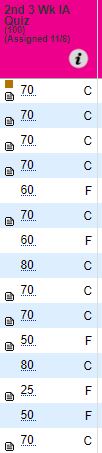
gradebook 1This was my policy from the beginning of the year, but I got too careless with it. I can’t force them to show, but I strongly encouraged them after this second six weeks. Some of the kids were great about coming in and others not so much. I started offering lunch tutoring to give them another opportunity to get help while at school. I let them eat in my class because I had to eat too. I did not offer this every day for my sanity, but only on Tuesdays and Thursdays, which was right after that class! Retesting is a pain, but I believe in it. How else will students learn from their mistakes? If they never look at a test and see what they missed, they will not grow and improve. It’s also good for me to see on an individual basis what their weak areas are and to give them one-on-one help. As you can see to the left, I document if they retested by putting a comment by the score.

My concentration during the 3rd six weeks besides retesting was making students talk about the math they were doing. I was doing a study on math discourse, so I was kind of forced to work on it. You would think after 32 years of teaching, that math discourse would be a big part of my teaching. I thought it was until I started this study. Desmos is a great tool for this as well as Flipgrid. In Desmos, there are lessons called Polygraphs. Students have to describe things to play the game and figure out the graph that the other student is thinking of. If you don’t have computer access for your students, you could totally create a similar game. One student picks a graph and the other person can only ask yes/no questions to figure out which graph was selected. You try to figure it out in as few questions as possible but students need to use math vocabulary! Both students have to understand the concept.

Flipgrid is another animal! It is an app or website where the teacher can ask a question and the student has to video their response. Wow, can I just say this showed me again how the students did not know the correct vocabulary or how to really explain what I asked. I used this several times, but the first time was when I asked them to explain how to graph a line that was in standard form. I felt like this deepened their understanding because I let them work alone to figure out what to say. They used a dry erase board to demonstrate as they were explaining. I loved this so much and I know it helped. Solving for y was a major ordeal, and I feel like most of them understand that as well as where the slope and y-intercept are in the equation and how to use them to graph.

I tried the rest of the year to use Desmos, Flipgrid, Quiz-Quiz-Trade, Collaboration Groups, Reflections and as much talk and explaining about the math that I could think of.

Step 5: Math Discourse is a Biggie, Folks! If you don’t do this, START NOW! I’m stupid for not using these things consistently in the past.

This takes us to the end of the first semester. I will continue this post in Part 2. Let all of this sink in for a while. Let the wheels turn. What can you change? 

Here’s a breakdown of what I suggest you do so far:

  1. Look at student data from their past math scores on the EOC and even their previous math classes.
  2. Don’t use calculators until you can’t stand it anymore or when it becomes really necessary!
  3. Study the Algebra TEKS and the Algebra EOC’s and start adding these questions to your tests and quizzes, then go over them consistently after the test/quiz.
  4. Allow the students to retest, but make them review the material first!
  5. Use Math Discourse as much as possible. Incorporate it daily or at least weekly. 

Go to Part 2!