Stay Organized and Minimize Distractions with Supply Boxes in the Classroom


I want to let you in on a little secret that was a game-changer in my classroom: supply boxes (pencil boxes used for supplies). I used these handy boxes for years, and let me tell you, they are a teacher’s best friend when it comes to reducing disruptions and keeping things organized. My largest classes were usually 28 – 30 students, so I kept 6 – 7 supply boxes. If we were not in groups, I kept them scattered around the room, so that students could share the supplies. I liked to use plastic pencil boxes, but a gallon plastic bag would do the job as well.
Benefits of Supply Boxes:
Let me start by saying that this teacher hack for material organization was a total lifesaver for me. Picture this: all the materials your students need for group work right at their fingertips, without having to get up and rummage around the classroom. It’s a game-changer! With supply boxes, you can say goodbye to constant disruptions and wasted instructional time. Engagement increases because students can get right to work and focus on the lesson. (You know how long it takes to get some students started just because they don’t have a pencil or some material they need.)

Another amazing benefit of supply boxes is the cleanup process. No more chaotic scramble to collect materials at the end of a lesson. Students work together to make sure all items go back into the box, making cleanup a breeze. Trust me, it’s a small change that brings big results. I can’t begin to tell you how much time this has saved!

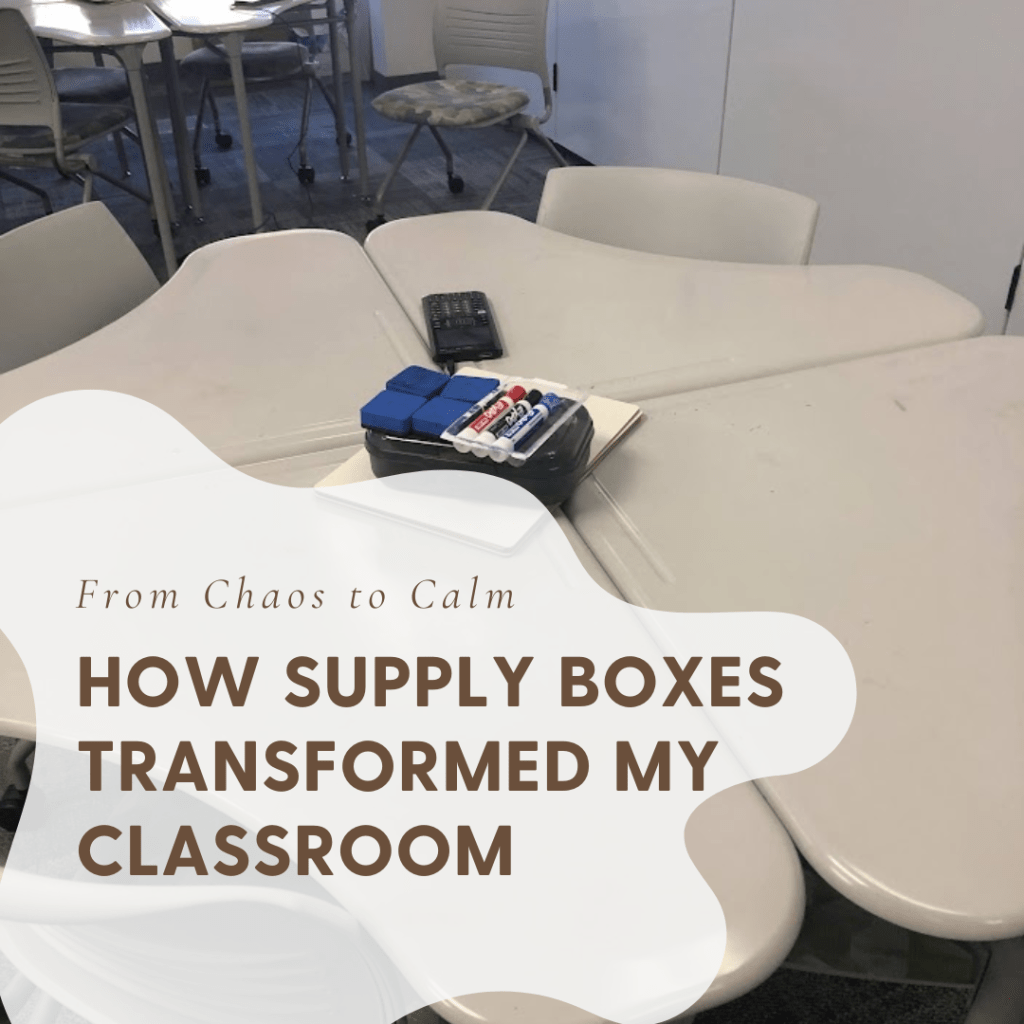
As you can see in the picture below, I had a place in my room for supplies and the supply boxes when I needed to clear the desks for various reasons. This is also the area where I restocked and added or took away materials.

Essential Materials for Supply Boxes:
Now let’s dive into the must-have materials for the supply boxes. I do not keep all these items in the boxes at all times. I periodically change out what they contain. Here’s my top twelve list with links to build your cart on Amazon:

  1. Pencils and pens ensure that students have the tools they need to work so that there are no excuses. A good idea if you like your students to grade papers, is to stick some red pens in the box. Here’s a link to some assorted colors.
  2. Pencil sharpeners. How often do students get up in the middle of a lesson to sharpen their pencils? This disruption does not have to happen if they have access to some small pencil sharpeners.
  3. Erasers. Mistakes happen, and having erasers readily available allows students to correct errors without hesitation.
  4. Scissors are versatile tools that come in handy during activities involving cutting and are great if your classes have interactive notebooks.
  5. Patty paper is a thin, translucent paper that is invaluable for math exploration. It allows students to trace shapes and transformations, making it an essential tool for hands-on investigations.
  6. Notecards offer a versatile way for students to jot down key concepts, vocabulary words, or important information. They can be used for individual or group review activities, making them an effective study aid.
  7. Sticky notes are fantastic tools for collaborative brainstorming and organizing ideas. Students can jot down their thoughts, stick them to a board, and easily rearrange them to create a visual representation of their collective thinking.
  8. Tape or glue sticks are essential for securing papers, attaching visuals, or creating interactive displays.
  9. Colored pencils add a vibrant touch to collaborative projects and presentations. They encourage creativity, differentiation, and visual appeal in various subjects such as art, graphs, diagrams, or illustrating concepts.
  10. Protractors are indispensable tools for measuring and drawing angles accurately. They enable students to explore geometry concepts, and they’re also great for drawing straight edges. I also like that they come with an inch ruler and a centimeter ruler. I keep rulers in my classroom, but since protractors fit well in the box, they are my go-to measuring tool.
  11. Highlighters allow students to emphasize important information, key details, or highlight specific parts of a text.
  12. How about placing Task Cards or a special piece of an activity in the box before class? I’ll change out an activity such as task cards so that the students already have what they need to start the lesson.

By providing students with well-stocked supply boxes, containing essential materials like pencils, erasers, scissors, rulers, and other items mentioned above, you will be able to cut down on time wasters and discipline issues. It makes the room more productive and less chaotic.

If you don’t have the budget to purchase these items yourself, then add them to the student supply list. One thing that runs out fast is tape. Put items such as tape, notecards and colored pencils on the student supply list so you can stock up and have plenty for the rest of the year. Good Luck and I hope to hear from you after you start using your supply boxes.

You will also notice I have dry erase markers, erasers (these erasers are awesome and are magnetic) and dry erase boards. It’s great to keep these out so you can use them at any moment. (All of these items come as a set if you’d rather purchase them together.)

Disclaimer: This blog post contains affiliate links. That means if you make a purchase through these links, I may earn a small commission at no extra cost to you. I only recommend products and resources that I personally find valuable and believe will benefit my readers. Your support through these affiliate links helps me continue to provide helpful content for educators. Thank you for your support!

15 End-of-Year Ideas to Keep Your Math Students Engaged

The end of the year is fast approaching and you’re probably wondering what you can do in your secondary math class to make the most of the time left. Here are some suggestions. See what will fit your situation!

  1. The obvious thing to do is review. You’ve covered a lot of topics throughout the year, so take some time to go over key concepts and formulas. Throw in some practice problems, games, technology, and hands-on activities to reinforce what has been learned. Reviewing is boring, so as you read down this list, use some of these strategies in your reviews.
  2.  Another idea is to assign a project that allows students to apply what they’ve learned to a real-world problem. This would be a great way to see math in action and flex their problem-solving muscles. An example would be to have students model real-world phenomena, such as population growth or temperature changes, using algebraic functions. This project would require students to apply their knowledge of function notation and graphing to real-world scenarios.
  3.  You will probably be giving exams, so another thing to talk about is test-taking strategies. Discuss how to read and interpret word problems, how to show work, and how to avoid common mistakes. Practicing these skills would be beneficial to show students how the strategy works. Teach your students how to make a brain dump. This is especially helpful for state exams.
  4.  Create a fun and engaging math competition for students to participate in. This can be a great way to end the year on a high note and showcase students’ math skills.
  5.  Offer individualized feedback to students on their performance throughout the year. This can help them identify areas for improvement and develop a growth mindset. If you have over 100 students, this could be a daunting task. Ask students to self-reflect first, then you could quickly add a statement or two and comment on what they felt were their strengths and weaknesses.
  6.  Recognize students who have excelled or improved in math throughout the year. This can be done through awards, certificates, or other forms of recognition. It’s also fun to give silly awards since, at this point in the year, you know the students so well.
  7.  Encourage students to set goals for themselves and create a plan to achieve them over the summer or in the next school year. It is a great skill to learn how to set goals. The great thing is that you don’t have to look at them. Have students type the goals in the notes on their phones and then encourage them to occasionally look at them to see their progress. 
  8.  Reflection activities can help students process their math learning and prepare them for future math classes. Some ideas are surveys, class discussions, journaling, writing a letter to their future self, and creating a portfolio with some of their best work.
  9.  Choose a math-themed movie or documentary to watch in class and use it as a springboard for discussion and learning. Some great options include “Hidden Figures”, “A Beautiful Mind”, “October Sky”, and “The Story of Maths”.
  10.  Create or have your students create math-themed board games that can be played in class. This is a great way to review key concepts while having fun with your students.
  11.  Group challenges encourage teamwork, foster critical thinking, provide a fun and engaging experience, build problem-solving skills, and promote healthy competition. Some group challenges are scavenger hunts, escape rooms, Kahoot, Quizizz, Jeopardy, debate, and so forth.
  12.  Take your students on a math-focused field trip to a museum, science center, or even a local construction site. This can help them see the practical application of math in the real world.
  13.  Bringing in a guest speaker would be a nice change and break up the monotony at the end of the year. It can inspire and motivate students, provide a different perspective, introduce new topics, build connections, and offer networking opportunities.
  14.  Peer tutoring is a great way to add something special to the end of the year in a math class. It encourages collaboration, builds confidence, reinforces learning, provides personalized learning, and promotes social skills.
  15.  Go outside if it’s feasible. Let students take their math notebooks and pencils and sit under a tree to study or take chalk outside and let students work on math problems on the sidewalk. Getting outdoors at the end of the year is a great way to refresh and rejuvenate yourself and your students!

It’s super important to plan out the end of the year for your math classes. You don’t want to bore your students with endless reviews and exams. Instead, make it fun with cool activities that connect what they learned to the real world. Personalized feedback is a must too, so get to planning and make the end of the year a blast for your students!

Here are some of my own resources that I tend to use at the end of the year:

Digital Activities in Math Should Still Require Showing Work

One challenge math teachers face using digital activities in the classroom is that students put down their pens/pencils and don’t pick them up at all while working on the assignment. How many times have you given a digital test and students do not work problems on paper? Do you notice they sit and stare at the screen and try to answer questions without the aid of working the problem out by hand? I think this is a big mistake on our part as teachers. We need to train students to show work even if they are filling out answers online.

Most math teachers require a journal or a notebook for notetaking. I believe that this is the perfect place to show work. Require students to date and title a page in their journal and work problems in an organized manner in the journal. The page can be a part of the overall grade of the assignment. Showing work will allow students to show steps, explain reasoning and they will have the ability to go back and find mistakes. A teacher only needs a quick glance to confirm the students did what they were supposed to do. Here are three things to consider:

  • If a student has hardly any work done, that is a sign that the student may not know what to do.
  • If students miss all the problems and don’t show work, they are clueless.
  • If students get all the problems correct and don’t show work, they may be cheating.

There is a direct correlation between the amount of work shown and how much a student understands.

For example, I use Boom Cards in my class. My students know, when working on the cards, they have a page in their journal dedicated to showing work on the assignment. I allow students to work the boom cards as many times as they want to get the grade they want. When they show work, they are able to look back at the work and see if they can find a mistake. I haven’t tried this next part but, what if I took this a step further? Have the students highlight incorrect problem(s) and, if they find their mistake(s), they write a quick statement analyzing the mistake. How much better will the math “stick” if they analyze their own mistakes? If you’ve never used Boom Cards, click on the picture below:

The one time I would not use the journal to show work is for tests. I like to provide a colored sheet of paper for showing work on a digital test. The paper must be turned in when the test is completed. Even better is to have a piece of paper that has space for each problem. If you don’t have time to print one, then have students fold the paper in half, then in half again and then again if you need that many places for answers. When students open up the paper, it is separated into 8 boxes on the front and back if the paper has been folded three times.

I recommend taking up the paper after the test rather than have them take a picture and upload it. Here is why: students take a picture of their work to upload it. Now, they have that picture to send to whomever, like a friend in a later class.

A digital place to show work could be on a Google Jamboard. I used Jamboards alot during Covid. Students can easily open a Jamboard if they have a Gmail and use a separate slide for each problem. The Jamboard only comes with 20 slides, so think about this before having them use it. The Jamboard can also be shared with whomever so, be sure they put their name on it.

Example of a Jamboard

As math teachers, we tend to make a big deal about getting the right answer, but just as important as a correct answer is HOW to get the answer. If we constantly use digital activities in our classes and we are never looking at student work, then we have no clue if students really understand what they are doing. Looking at the work does not have to be time-consuming. You can quickly know if the work is legitimate or gibberish. You can catch cheaters by requiring work as well.

If we get away from having students show work, we are doing them a disservice. Our job as math teachers is to create problem solvers. It is hard to solve problems without going through steps or explaining how the solution is derived. Let’s change the way students think about digital activities and train them to show their work.

Making Mistakes in Math

Say this to yourself: “I make math mistakes and it’s ok!” Most of the mistakes we make as teachers are probably because of being careless. Our minds are processing 20 different things while we are teaching. We are wondering if the students are understanding or if Susie is on her phone or if Johnny is ever going to come back from the restroom. 

Make it known from the beginning of the year that you WILL make mistakes and you need the students to catch those mistakes. If they catch the mistake, then give them bonus points or a sticker or some reward to let them know it’s important that they notice your mistakes. Also tell your students that you do not know everything about math. That might shock them. You need to show vulnerability so that the students feel comfortable about their own mistakes. When you make a mistake and a student points it out, say THANK YOU!

Something that I have said many times this year is that I want the students to be wrong… a lot. I want them to mess up. I want them to make mistakes. I want them to leave the class and say, “Well I made a lot of mistakes today in math.” Weird, I know…but if they can say that, then they worked hard in class. Mistakes are a part of learning. Mistakes mean effort. No mistakes will probably mean no work. 

Have you asked a student a question and they say, “I don’t know?” Tell them they can’t say that anymore. Do not let them write IDK for an answer on a paper. That’s a big no no. I tell the kids to “Fake it until you make it.” Act like you know. Put something down or give some sort of answer. Who cares if you are wrong! 

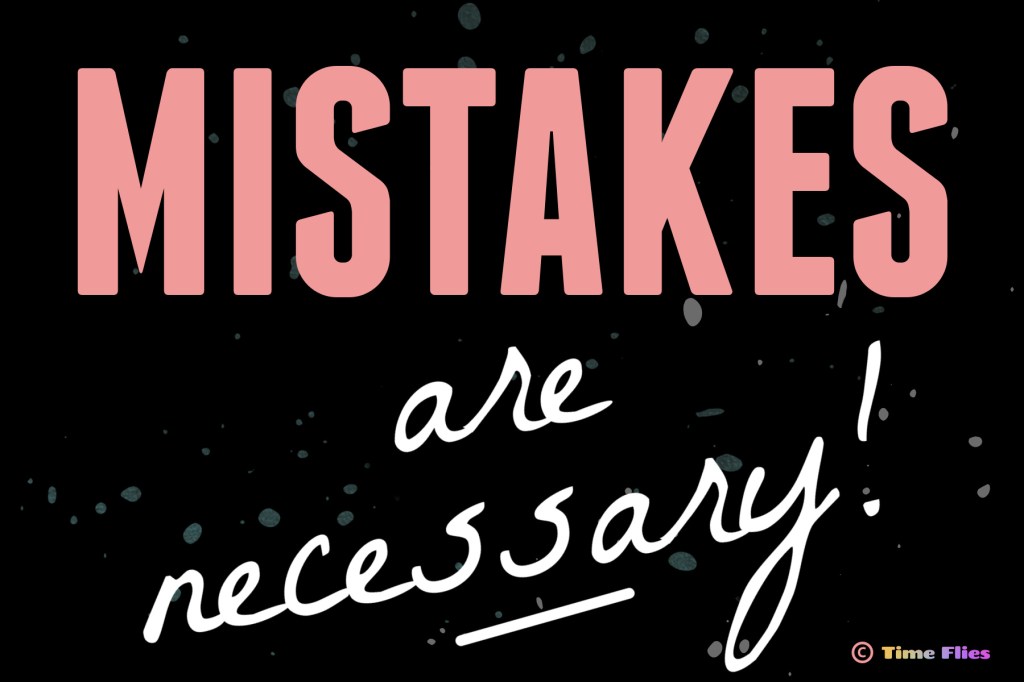
Next week when you are teaching, look at your students and see who is just sitting. Walk the room. Who has a blank paper. Don’t let this happen. Get the students involved and teach them to be ok with math mistakes. Mistakes are necessary! 

(Here is a gift to you. A digital display poster of Mistakes are Necessary. This is from my Google Drive… if you cannot open it, try from your personal email and not your school email.)

This post was a newsletter first. This is the kind of content that I like to write for my email subscribers. If you’d like to be a part of my email list, sign up here. My goal is to provide tips, ideas and resources for the busy secondary math teacher or tutor. If that’s you, please join.