What Unfolds in Your Math Class When the Bell Rings?

The bell to start class just rang. Now what? Let’s talk about those classroom openers that go by many names – “bell ringers”, “warm ups”, or “do nows”. After over 35 years in the teaching game, I’ve had my fair share of experiences with these little classroom kickstarters. You could say that bell ringers (or your preferred name) and I have a bit of a “frenemy” relationship. Why? Let me elaborate on the advantages and challenges I’ve experienced with bell ringers throughout my career.

As we head into a new school year, I’ve been thinking about what still works — and what needs a refresh. Bell ringers are one of those things that can either work for you or they can be a challenge. It’s important to know how to use them properly and to realize the purpose.

The Value of Bell Ringers

First things first, let’s acknowledge the credit bell ringers deserve. They can truly elevate your teaching game. Once seamlessly integrated into your daily flow, most students will fall in line. When students enter the room, they dive straight into the bell ringer activity. This gives you some precious moments to tackle all those initial tasks that need attention – like attendance, catching up with absentees, and the never-ending quest for missing assignments.

Wondering how to make this streamlined approach a reality? It’s all about setting the groundwork from day one. Here’s the deal: let your students know that the next time they walk into the classroom, there will be a bell ringer or directions on the board waiting for them, and they should start on it right away. Consistency is key here – when you establish this routine early on, students will come to expect it and know exactly what’s coming their way.

But that’s not all. Having them dive into the bell ringer gets their gears turning. It’s like flipping a switch that says, “Time to learn, folks!” The activity itself helps reel in their focus, and guess what? It prevents those precious minutes from vanishing into thin air. Trust me, math teachers know how to squeeze every ounce of learning time from the clock.

What adds to the charm of bell ringers is their versatility. They can serve specific purposes within your lesson plan. Whether reviewing a topic, accessing material that might otherwise be overlooked, or even acting as a captivating lesson hook – a purpose-driven bell ringer provides valuable insights to educators while aiding students’ comprehension of topics and sparking their interest.

I often used bell ringers to prepare students for upcoming exams such as in-school ACT, SAT, or state tests. Additionally, I found value in conducting reviews of past topics and addressing areas where I knew many students have learning gaps.

Let’s Talk Challenges Now

It’s important to know that bell ringers don’t always go as planned. One big issue is treating them as just something to pass the time. If students think they’re not important, they might not take them seriously. Have you ever had a student ask, “Does this count for a grade?” That’s their way of saying, “I’ll only do it if it matters.” So, the trick is to make sure they have a clear purpose. Even if grades aren’t involved, helping students understand how the bell ringer helps their learning is key. It is also important that students know that once they are finished with the bell ringer, there’s a good chance that someone in the room will have to explain how to work the problem or even go to the board and work it. If students feel like they might get called on, they will not want to get caught off guard.

There were times when I was in a pinch and had to create a bell ringer on the fly, without much preparation. It’s no secret that students can sense when things are a bit disorganized. You see, the whole “Fake it until you make it” idea doesn’t work well in teaching. You can’t pretend to be organized. With a classroom full of around 28 students, there’s just too much happening. You’ve got to be on your A-game. Teaching requires real organization and being genuinely ready for what’s ahead. So, take it from someone who’s been through it – staying organized is a true game-changer and that applies to having a prepared bell ringer.

There have been times when I decided to stop doing bell ringers altogether, or at least in some classes. During remote learning, my bell ringers didn’t translate well online, so I paused them for a while. The important thing is, it’s okay to change things up when needed.

Transitioning from one activity to another can make or break the classroom atmosphere. There were years when after the bell ringer, things got a bit crazy until I could get things back on track. Realizing the importance of fewer disruptions in certain classes, I chose to skip bell ringers to stay focused and keep my sanity intact. By the way, transitions can be smooth. If you give clear directions on what to do next and even set a timer, they can go better.

The biggest reason that I have a love-hate relationship with bell ringers is the significant time investment required to either source or craft them. It can feel counterintuitive to dedicate an hour to creating something that’s intended to occupy just around 10 minutes or less of valuable class time.

Purpose Matters

If you’re set on doing bell ringers, give them a purpose. Before going any further on your quest for bell ringers, stop and write the purpose the bell ringer will serve. Here are some suggestions:

  • It will be a hook for the lesson.
  • It will be a digital task.
  • It will be a review of the previous day.
  • It will be state testing review.
  • It will be college readiness review.
  • It will be spiral review.
  • It will be a writing task.
  • It will be a seasonal math task.

Once you lock in that purpose, you can hunt down the material. You need to think about how much time you want to spend on the bell ringer in class. That will help determine how many questions you want to have. I’ve listed some ways to come up with the problems:

  • Search real-life examples so the problems have meaning.
  • Use Desmos activities and spread them out over a week.
  • Write questions that are similar to the homework.
  • Use released test questions from your state tests or from college entrance exams.
  • Grab problems out of the math book at the end of units for spiral reviews.
  • Use AI generated questions. Beware! AI is not always great with math.

Now that you know your purpose and where your material is coming from, what format do you want to use? I’ve done different things, but one of my favorites is a three question approach where the first two questions scaffold for the third question. I’ve used this format in my ACT Bell Ringers as well as my SAT Bell Ringers. Day 26 from the SAT Bell Ringers is seen below:

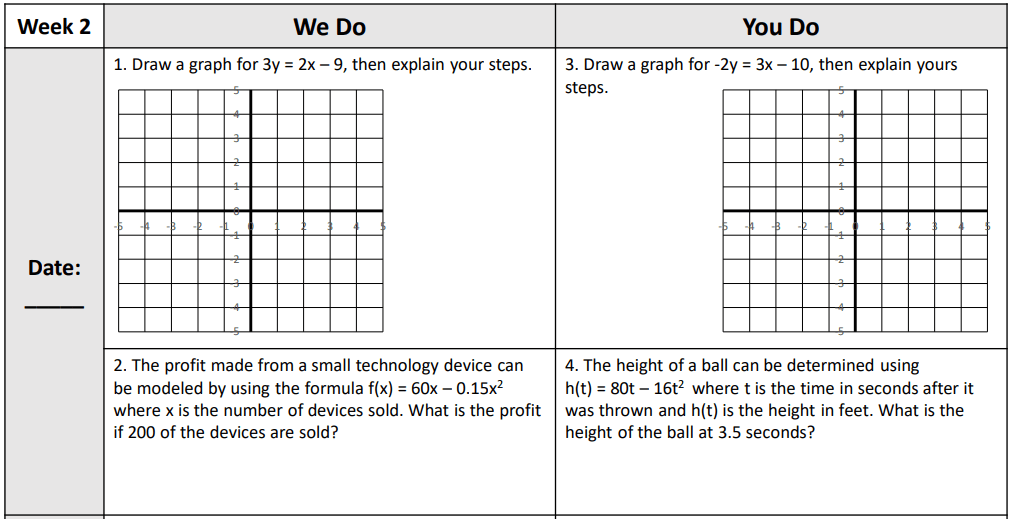
Another option is “We Do, You Do”. Together with the class, the teacher works through 1 and 2 and then lets the students work by themselves on 3 and 4. In this format, the teacher will begin class working the problems. When students work the other two, she can go do her attendance and other tasks. This approach is good when you have students that have a hard time starting. The example below is from my Algebra Review Bell Ringers.
Recently, I’ve been developing a new style of bell ringers designed with differentiation in mind. Instead of every student working through the same set of problems, this format allows students to choose from multiple levels of challenge based on their confidence and readiness that day.

This approach keeps all learners engaged—whether they need a little extra support or are ready to stretch their thinking. It also builds student independence, since they’re making decisions about how to approach the task. These differentiated bell ringers aren’t uploaded just yet, but they’re on the way. I’m excited to share them soon!

Your Bell Ringer Investment

Most of us do not want to spend our precious teacher planning period on bell ringers, so we end up working on it at home. If you decide to create these bell ringers yourself, then by all means save them so you have them for the next year. Make your time investment work for you in the future.

If you decide that recreating the wheel is not for you, then you can look at what I have. I’ve bundled up my most-used bell ringers from over the years to save others some prep time. Whether it’s Geometry, Algebra, or even a sprinkle of Trig, there’s plenty of things to choose from. Check out the resource after the final paragraph. You can look at the individual items and purchase them separately too.

In closing, the journey with bell ringers is an exploration of balancing their benefits and challenges. As educators, we adapt and refine our approach, always seeking the best ways to engage our students. Whether you’re harnessing the power of purpose-driven bell ringers, navigating their quirks, or even deciding to take a break when necessary, remember that your dedication to creating a meaningful learning experience remains at the heart of it all. With purpose as your guide, you’re well on your way to transforming those initial moments into impactful stepping stones towards an enriched classroom experience. Keep up the incredible work, and keep those bell ringers ringing with purpose!

From Roots to Fruits: An Engaging Journey for Your Algebra Students

I’m thrilled to introduce a versatile algebra resource that will take your students on an exciting journey through the world of algebra. At the beginning of the year, I like to introduce students to the origins of algebra, give them some idea of why they need it and to give them some relief that they are prepared for this moment because of their background in math. In the past, I’ve addressed this in a disconnected manner. For the first time, I’ve actually created a resource that takes students on this journey in a fun and organized fashion. I’m excited to give you an opportunity to use it in your classroom this year.

The presentation is offered in several ways so that teachers can choose the option that fits their needs. Do you want a teacher-led presentation or do you want self-directed work? Would you rather the students work through a Boom Card activity? The teacher-led journey and the student self-directed exploration are included in one resource. The Boom Card activity is in a separate resource since not all teachers are familiar with this type of application. Check out the descriptions of each below:

  • Teacher-Led Journey:
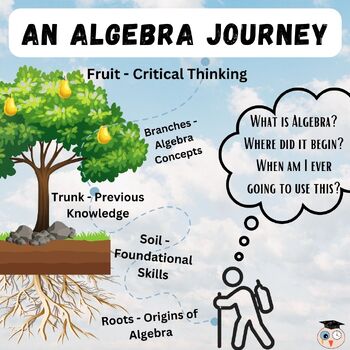
    The teacher-led journey is captured through a PowerPoint. To make it easy on the presenter, I’ve included a teacher guide that provides clear instructions, ensuring a seamless experience as you navigate the presentation. Your students will participate in the reading of the slides, answering some math questions along the way and they will be creating a picture of a fruit tree that represents their journey. (Roots – origins of algebra, soil and rocks – the foundational skills needed and so forth.)

  • Self-directed Exploration:
    Recognizing that every classroom is unique, I’ve also included alternative options for student-led exploration. The Google Slides version allows your students to take control of their learning, engaging in a “scavenger hunt-style” activity at their own pace. Teamed up with a Google Forms companion, your students can answer questions, solve math problems, and reinforce their understanding while enjoying the freedom to explore independently or collaborate with a partner. While progressing through the Google Forms, students will have the opportunity to simultaneously create the picture of the fruit tree.
  • Boom Card Adventure:
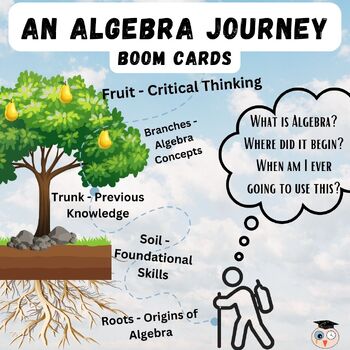
    To add an interactive twist to the learning experience, I’ve created a Boom Card activity. Your students can embark on an exciting adventure through a series of engaging digital cards, answering questions and deepening their understanding in a fun and gamified format. The Boom Cards offer an exciting way to reinforce concepts and keep your students motivated as they progress on their algebraic journey. No tree is created in this activity, but the slides are basically the same as the presentations referred to earlier with the addition of some mulitple choice and matching questions. This self-graded option is perfect if you are fond of Boom Cards and you want your students engaged. They can work through the cards as many times as you will let them.


This resource addresses common student questions, such as “What is algebra?” and “When will I ever need it?” By launching this algebraic adventure, your students will gain a deeper understanding of the subject’s origins, its practical applications, and its relevance in their daily lives. Through a combination of visual aids, interactive activities, and thought-provoking questions, this resource aims to introudce algebra in a fun and eye-opening way. The Algebra Journey Activities are below. The poster is a freebie and fits well with the activity. Go take a look and good luck this year!

Stay Organized and Minimize Distractions with Supply Boxes in the Classroom


I want to let you in on a little secret that was a game-changer in my classroom: supply boxes (pencil boxes used for supplies). I used these handy boxes for years, and let me tell you, they are a teacher’s best friend when it comes to reducing disruptions and keeping things organized. My largest classes were usually 28 – 30 students, so I kept 6 – 7 supply boxes. If we were not in groups, I kept them scattered around the room, so that students could share the supplies. I liked to use plastic pencil boxes, but a gallon plastic bag would do the job as well.

Benefits of Supply Boxes:
Let me start by saying that this teacher hack for material organization was a total lifesaver for me. Picture this: all the materials your students need for group work right at their fingertips, without having to get up and rummage around the classroom. It’s a game-changer! With supply boxes, you can say goodbye to constant disruptions and wasted instructional time. Engagement increases because students can get right to work and focus on the lesson. (You know how long it takes to get some students started just because they don’t have a pencil or some material they need.)

Another amazing benefit of supply boxes is the cleanup process. No more chaotic scramble to collect materials at the end of a lesson. Students work together to make sure all items go back into the box, making cleanup a breeze. Trust me, it’s a small change that brings big results. I can’t begin to tell you how much time this has saved!

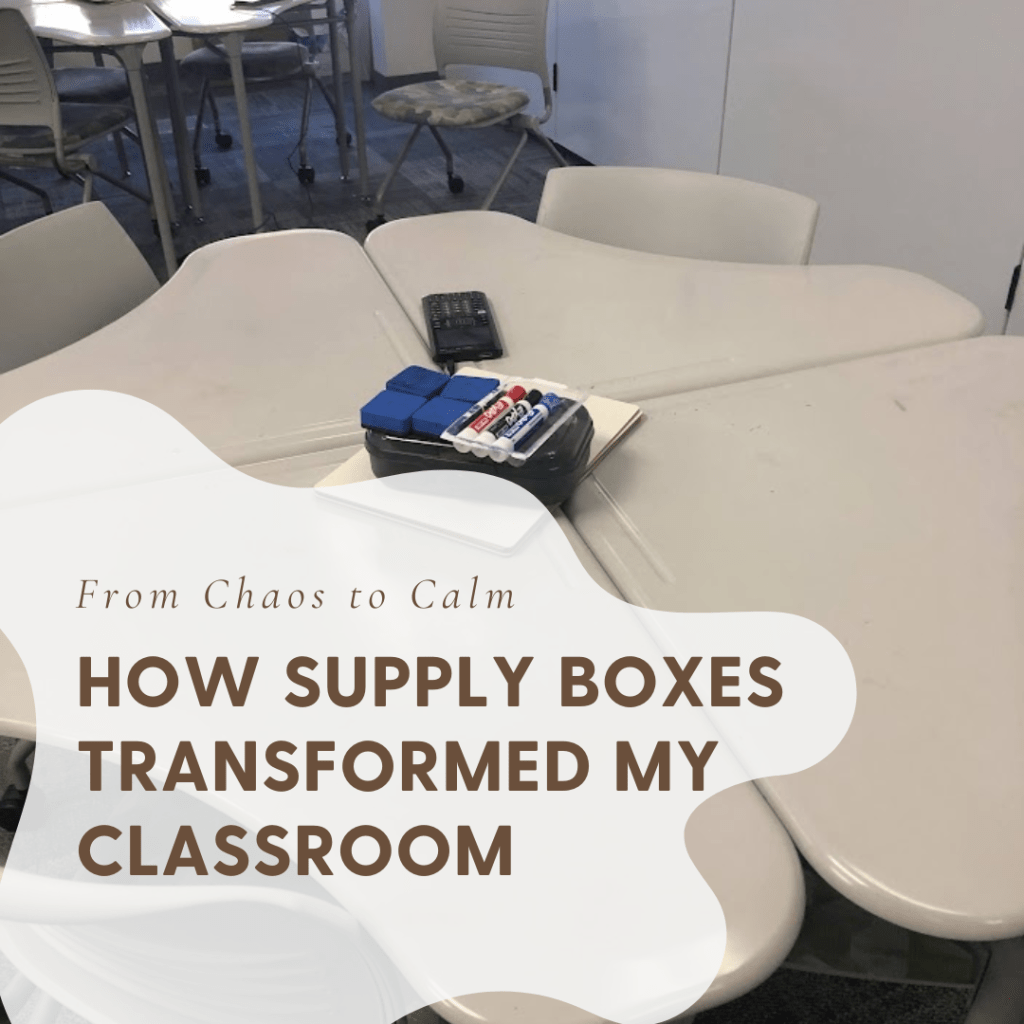
As you can see in the picture below, I had a place in my room for supplies and the supply boxes when I needed to clear the desks for various reasons. This is also the area where I restocked and added or took away materials.

Essential Materials for Supply Boxes:
Now let’s dive into the must-have materials for the supply boxes. I do not keep all these items in the boxes at all times. I periodically change out what they contain. Here’s my top twelve list with links to build your cart on Amazon:

  1. Pencils and pens ensure that students have the tools they need to work so that there are no excuses. A good idea if you like your students to grade papers, is to stick some red pens in the box. Here’s a link to some assorted colors.
  2. Pencil sharpeners. How often do students get up in the middle of a lesson to sharpen their pencils? This disruption does not have to happen if they have access to some small pencil sharpeners.
  3. Erasers. Mistakes happen, and having erasers readily available allows students to correct errors without hesitation.
  4. Scissors are versatile tools that come in handy during activities involving cutting and are great if your classes have interactive notebooks.
  5. Patty paper is a thin, translucent paper that is invaluable for math exploration. It allows students to trace shapes and transformations, making it an essential tool for hands-on investigations.
  6. Notecards offer a versatile way for students to jot down key concepts, vocabulary words, or important information. They can be used for individual or group review activities, making them an effective study aid.
  7. Sticky notes are fantastic tools for collaborative brainstorming and organizing ideas. Students can jot down their thoughts, stick them to a board, and easily rearrange them to create a visual representation of their collective thinking.
  8. Tape or glue sticks are essential for securing papers, attaching visuals, or creating interactive displays.
  9. Colored pencils add a vibrant touch to collaborative projects and presentations. They encourage creativity, differentiation, and visual appeal in various subjects such as art, graphs, diagrams, or illustrating concepts.
  10. Protractors are indispensable tools for measuring and drawing angles accurately. They enable students to explore geometry concepts, and they’re also great for drawing straight edges. I also like that they come with an inch ruler and a centimeter ruler. I keep rulers in my classroom, but since protractors fit well in the box, they are my go-to measuring tool.
  11. Highlighters allow students to emphasize important information, key details, or highlight specific parts of a text.
  12. How about placing Task Cards or a special piece of an activity in the box before class? I’ll change out an activity such as task cards so that the students already have what they need to start the lesson.

By providing students with well-stocked supply boxes, containing essential materials like pencils, erasers, scissors, rulers, and other items mentioned above, you will be able to cut down on time wasters and discipline issues. It makes the room more productive and less chaotic.

If you don’t have the budget to purchase these items yourself, then add them to the student supply list. One thing that runs out fast is tape. Put items such as tape, notecards and colored pencils on the student supply list so you can stock up and have plenty for the rest of the year. Good Luck and I hope to hear from you after you start using your supply boxes.

You will also notice I have dry erase markers, erasers (these erasers are awesome and are magnetic) and dry erase boards. It’s great to keep these out so you can use them at any moment. (All of these items come as a set if you’d rather purchase them together.)

Disclaimer: This blog post contains affiliate links. That means if you make a purchase through these links, I may earn a small commission at no extra cost to you. I only recommend products and resources that I personally find valuable and believe will benefit my readers. Your support through these affiliate links helps me continue to provide helpful content for educators. Thank you for your support!

Summer Reading for Secondary Math Teachers

Summer is almost here and teachers and their students cannot wait. I personally love summer and all that comes with it including time to read. Reading for pleasure is my favorite, but it’s equally fun for me to read about my interests. The last book I read was by math education expert Jo Boaler titled “Mathematical Mindsets: Unleashing Students’ Potential Through Creative Math, Inspiring Messages, and Innovative Teaching.” I love how Jo Boaler believes that all students can learn math and it really is about nurturing a growth mindset.

Here are a few suggestions for math books that will inspire and give you new insight into the wonderful world of teaching mathematics. These books were selected because they will be enjoyable and hopefully will not remind you of a boring inservice!

“Visible Learning for Mathematics: What Works Best to Optimize Student Learning” by John Hattie, Douglas Fisher, and Nancy Frey. (paperback version or Kindle version)

“What’s Math Got to Do with It?: How Parents and Teachers Can Help Children Learn to Love Their Least Favorite Subject” by Jo Boaler. (paperback version or Kindle version)

“It’s a Numberful World: How Math Is Hiding Everywhere” by Eddie Woo. (paperback version or Kindle version)

“Math with Bad Drawings: Illuminating the Ideas That Shape Our Reality” by Ben Orlen. (paperback version or Kindle version)

100 Ideas for Secondary Teachers: Supporting Students with Numeracy Difficulties (100 Ideas for Teachers)” by Patricia Baptie and Sue Dillon. (paperback version or Kindle version)

Now that you’ve looked at the list, grab a cool drink, find a cozy spot, and dive into the world of math education through these inspiring reads.

If you will be teaching for the first time next year, I have a blog post that you should read called 1st Week of Math Class Ideas. Good Luck!

***Please be aware that as an affiliate marketer, I may earn a commission for any qualifying purchases made through the links provided in this blog post. This commission comes at no additional cost to you. I only recommend books and products that I genuinely believe will be valuable to you as a math teacher. Thank you and happy reading!