First Week of Math Class Ideas

You may be wondering what the first week of math class should really look like — especially if you’re teaching middle or high school. Maybe you’re aiming to make everything perfect, or maybe you’re just trying to survive the chaos.

Either way, I’ve been there. I spent over 35 years in the classroom, and I always believed the first week was about more than content. It’s about systems, structure, and connection.

So here’s what I recommend (and what I used myself) for that first week of school.

Start with a Plan and a PowerPoint

For new teachers, I recommend using a PowerPoint on Day 1 to walk students through your rules and procedures. If you’ve read Harry Wong’s First Days of School, you know how powerful this foundation can be. If you’re a veteran teacher, you might prefer to break up the PowerPoint across the week and mix in more community-building and routines practice.

About Me + Name Plates

As students walk in on the first day, I have two things waiting on their desks:

  • An “About Me” page (as bell work)
  • An index card to make a nameplate (Suggestion: Use colored index cards — a different color for each class)

The folded nameplate helps me learn names quickly and gives students something productive to do. I keep these nameplates all year, clipped by class — super handy for randomly calling on students or activities where I move seats.

I keep all name plates for each class on a clip as shown above.

YouCubed

The other thing I liked to do during the first days of my math class was use activities from YouCubed. The ones I focused on came from the Week of Inspirational Math(s). I’ll give more specifics in my weekly plan.

Sample Weekly Plan (Block Schedule)

Mon/Tue

Secondary Math – 1st Week of School
  • Bell Work: “About Me”
  • First Day PowerPoint
  • Make Name Plates
  • Send home parent forms
  • Scavenger Hunt + Syllabus

Wed/Thu

  • Hand out name plates again
  • Finish any leftover intro tasks
  • YouCubed “Four 4’s” activity
  • Start Collatz Conjecture (“Oh Hail the Elephant“) if time allows.

Friday

  • Wrap up Collatz
  • Another YouCubed activity (like Building Shapes, as shown in the picture)
  • Reminder: Supplies needed for Monday + weekend paperwork

Want This All Ready to Go?

Take a look at my 1st Week of School for the Secondary Educator in my TpT Store.

Here’s What’s Inside:

  • Editable Scavenger Hunt: A customizable way to familiarize students with the classroom.
  • Editable Syllabus Template: Easily customize to fit your classroom policies and curriculum.
  • “Get to Know You” Activities: Fun and engaging ways to learn about your students.
  • Parent Contact Forms: Communicate with parents from day one.
  • First-Day PowerPoint: Kick off the year with a polished presentation.

I hope this gave you ideas or reassurance that it’s okay to take your time the first week. And don’t forget to collaborate with your team — every teacher does things a little differently, and that’s okay.

Wishing you a great year ahead!
Lisa
Time Flies Math

Disclaimer: This post contains affiliate links. If you make a purchase, I may receive a small commission at no extra cost to you.

Give Your Students Hope on a Math Test

Semester finals are coming! Of course you will review and try to prepare your students, but time is limited. How can you help your students do better and still keep your standards high?

USE   AN   ANSWER   BANK.

If you have a 20 question test and you have 20 answers in an answer bank, your test is still challenging but you are giving your students hope which means they will put more effort into trying! That’s what we want, right? EFFORT! 

Will some students guess by using the answer bank? Absolutely! When I give an answer bank, I have two rules:

  • Students have to keep the test for a certain amount of time before turning it in.
  • Students have to show work on all of the problems. 

Try it this year. I think that you will be pleasantly surprised. If students feel like they have an advantage, it makes a big difference in their attitude. Please let me know how this goes for you.

I have two final assessments with answer banks if you would like to try them. (My Algebra 1 Final with an Answer Bank is in the works. Be on the lookout for it soon!)

Finals with answers banks are below:

Algebra STAAR 3 Week Review

Here we are again getting ready for another Algebra STAAR test. Last year was crazy and very hard to prepare students. This year is just as challenging, but in a different way. Last year, no one expected much from the students. Learning math online is super tough. This year, the expectations will be higher. We’ve had a full year of being back in a building. Students have learned more this year, but how will they perform after having some pretty dramatic learning loss from the past few years?

We are well into the 5th six weeks at this point and I only have quadratics left to teach. As far as reviewing for the STAAR, I’ve started a few things. We made STAAR flashcards from the task cards that are in one of my resources and students have done some of the boom cards to practice fill-in-the-blank questions. I’m going to start tutoring once a week after school and invite students that did poorly on the Algebra STAAR benchmark we just gave at the end of February. I will begin a three-week focused STAAR review on April 11th.

Here’s my plan for the last three weeks leading up to the test: (You will not see much on quadratics in this review since this is the topic that was just completed.)

Week 1: Bell Ringers for the next two weeks will be key features of linear, quadratic and exponential graphs. Obj. 4 – Correlation Coefficient and scatterplots for quadratics and exponential functions. Obj. 12(b, c, d) – Evaluating Functions and Algebraic and Geometric Sequences.

Week 2: Domain and Range for Linear, Quadratic & Exponential (Obj. 2a, 6a, 9a). Review of Systems (Obj. 2i, 3f, g, h, 5c). Review of Slope and Graphing Linear Functions (Obj. 3b and d).

Week 3: Start a brain dump. Use the brain dump for bell ringers. Obj. 5a – Solving Equations, Obj.10e – Factoring, Obj. 11b – Laws of Exponents

*I cannot plan for other students that are not mine, but this is a general plan that should work for most situations. Think about your own students and what their strengths and weaknesses are!

**These topics were strategically selected by analyzing past Algebra STAAR exams and knowing the Readiness Standards.

All of this material is in one place in my store if you are interested in purchasing. Click on the pic below to find it in my store:

Help Struggling Students Factor Quadratics

It’s the truth! Factoring is a major topic and somehow, we have to make sure students can do it. Factoring is needed for all math classes after Algebra and for all college entrance exams (SAT, PSAT and ACT) and placement exams (ACCUPLACER and TSI). Algebra teachers have enough on their plate without this pressure, but it’s our job to teach it and hopefully it will be reinforced in future math classes.

About ten years ago, one of my coworkers showed me a cool calculator method that I use with struggling students. Some students have a hard time with their multiplication facts which will make factoring a nightmare for them.

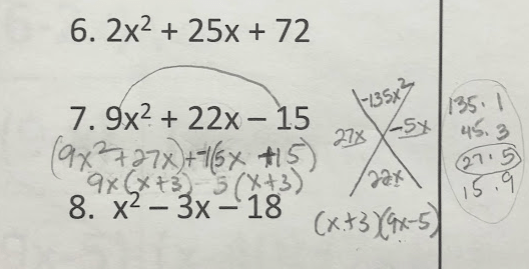
I hate most calculator tricks, but this one is actually a great tool. Let’s say a student needs to know all the factors of 135. Have them go to the graph of the calculator and type 135/x (135 divided by x). Next have the student look at the table. In the table, they will look for whole number values. For instance, across from an x of 1, is a y of 135. That of course means that 1 and 135 are factors of 135. The next set of whole number values are x = 3 and y = 45. When the list of numbers starts repeating, all of the factors have been found.

Look at the sample factoring problem below this paragraph. I have my students multiply the 9x^2 and the -15. The answer is -135x^2. To the right of the problem, they draw a large X . On the top, they write the -135x^2 and on the bottom of the X, they write the middle term: 22x. Next, they start making a list of all of the factors of 135. I tell them not to think about the negative at first…just make a list of factors. If they are not able to do that, then use the calculator to make the list. Once the list is made, then the students decide which factors will multiply to get -135 and subtract to get 22. The answer would be 27 and -5. Those two numbers are written on the left and right side of the X. Next, the original trinomial is turned into a polynomial with four terms. The second step below was 9x^2 + 27x – 5x – 15, before I started the grouping process. The problem is grouped and the factors are found. (Yes, I teach grouping. It helps with this type of problem and it helps with factoring out a GCF. Don’t skip grouping. If you’d like to see more about how I teach factoring go to this Factoring Blog Post.)

Here’s a quick video explaining the same problem:

All students can factor! Believe it, teach it and recycle it!