Algebra – 2nd and 3rd Grading Periods – Moving Toward the STAAR!

This is a continuation of some of my earlier posts. I was so proud of my students last year for passing the Algebra STAAR, so I wrote about it here: How I Got a 100% Passing Rate on the Algebra EOC Part 1 and Part 2.

I promised that I would keep anyone interested up-to-date this year on my progress. I love doing this because I’m going to be able to look back and see where I want to improve after I get my results this year. Here’s my post on the first six weeks: First Six Weeks in Algebra I

I lumped the 2nd and 3rd 6 weeks together in one post because I have so many interruptions during this time. Every time I turn around there’s a field trip, a district benchmark, PSAT, TSI or other disruptions. My strategy has been to get through as much content as possible. I know my students very well at this point and I know who to keep an eye on.

The content that we’ve covered heavily is seen below:

I’ve pressed on and given lots of quizzes, tests and homework.

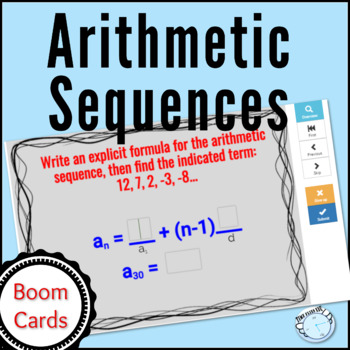
Some of my favorite activities have been some boom cards that I’ve made. The set of cards in the the resource below has 20 questions. Click here to go do the first four cards in the student view.

So far I haven’t pulled many questions of old STAAR test. Their minds were blown when I was explaining the recursive formula in arithmetic sequences. I did look back into old STAAR test to see how often sequences have been tested. The only question I could find from the the past three years was this problem from the 2017 released test:

In general, arithmetic (and geometric) sequences are not a big part of the test. The 2019 test did not have any questions on the topic. This question below is from the 2018 test:

I suspect that they rotate questions from the TEKS and that next year there will be at least one question like #22 or #9 above.

I wanted to start some recycling of the first six weeks through practice sheets like I did last year but life happens and I did not start this. (Side note: I’ve been teaching for 33 years. I always make plans to do this or that, but I’ve learned that I cannot always get to everything. Please don’t beat yourself up if you do this too. A lot of things in education and the school environment cannot be controlled. Don’t worry if you have visions of grandeur but it doesn’t always work out.) One thing I do feel good about is that I do not let the students use a calculator every day. They have to do math in their head. They did a lot of solving for y and manipulating formulas so they did get a taste of some of the things from the first six weeks which was mostly solving equations. Another thing I feel ok about is I know that I’m about to do systems which will also be good for practicing solving equations. We will also hit inequalities again through systems, so recycling information is going to happen naturally!

While on the topic of systems, if you are behind in your curriculum, this is a good time to try to catch up. Systems are important, but you can save solving for systems for after the STAAR test. Teach them how to set them up and solve them on the calculator for now. I hate this, but at the same time you have to make sure you cover all the material. Save solving systems algebraically for later if you need to.

I promised myself that I would make sure and have students explain the math they were using more. I wanted to know if they really understood how to solve for y and graph equations, so I made a flipgrid question when we got to solving and graphing inequalities. The students really enjoyed it and it was an eye opener for me. Students have a hard time with the vocabulary and I could tell who was bluffing their way through explaining the process.

The second semester has started and now it’s crunch time. I have to be deliberate in everything we do. We are starting with graphing and writing linear systems and then on to exponent rules. Check back to see what happens next!

This comes in a regular version too!

Examples of Real-Life Arithmetic Sequences

One of my goals as a math teacher is to present real-life math every chance I get. It is not always easy, I have to admit. When I was in college and the earlier part of my teaching career, I was all about the math… not how I might could use it in real life. I’ve made it a goal of mine to find real-life situations. I’ve also tried to catch the situation in action, but it’s not always possible especially since sometimes I think of an idea while driving or when I’m falling asleep at night.

My recent thoughts have been about arithmetic sequences. Seems easy, right? They are linear. There are a ton of linear situations. Yes, but I want visuals! I also did not want the situation to be a direct variation or always positive numbers and always increasing or positive slopes.

Below are some of the situations I’ve come up with along with a picture. I’m happy for you to use these situations with your classes. When you are finished reading this post, please consider filling out this feedback form called: Understanding Our Visitors. Enjoy!

Stacking cups, chairs, bowls etc. (Stacking anything works, but the situations is different when one thing fits inside the other.) The idea is comparing the number of objects to the height of the object.

Pyramid-like patterns, where objects are increasing or decreasing in a constant manner. Ideas for this are seats in a stadium or an auditorium. A situation might be that seats in each row are decreasing by 4 from the previous row. I use this in one of my arithmetic sequence worksheets.

Filling something is another good example. The container can be empty or already have stuff in it. An example could be a sink being filled or a pool being filled. (Draining should also be considered!) The rate at which the object is being filled versus time would be the variables.

Seating around tables. Think about a restaurant. A square table fits 4 people. When two square tables are put together, now 6 people are seated. Put 3 square tables together and now 8 people are seated. I really love this example. You can use a rectangular table as well and start off with 6 seats.

Fencing and perimeter examples are always nice. Discuss how adding a fence panel to each side of a rectangular fence would change the perimeter. Figure one could have one panel on each side (or change it so it isn’t square). Figure two could have two panels on each side. Each time find the new perimeter. The possibilities for fencing are endless. But how fun would it be to get actual toy fence pieces and do this in your classroom?!

Even though this is not particularly a real-life situation, it’s still good because the visual is real life. The students can touch the objects or even create the pattern themselves! Use toothpicks, paperclips or even cereal to make patterns. If you’d rather set them up somewhere in the room for math centers, then that would be good too! The following is an idea with cereal. If you count total Froot Loops, it’s not arithmetic, so it’s best to stick with rows, perimeter, or sides of the triangle to stay with a linear pattern. (Counting all of them is an area problem, so that would make it quadratic.)

Negative number patterns are not as easy to find. Our thoughts usually go to temperature or sea level. There are some fascinating places on earth that are below sea level. I think it would be cool to do a study on some of them. Once you’ve talked about some of these places, then various situations could be created like, during a rainfall the surface of the water started at 215 feet below sea level and rose at a rate of such and such per hour.

Situations involving diving in the ocean could be used as well. Did you know that a diver should descend at a rate no faster than 66 feet per minute or ascend at a rate of no more than 30 feet per minute? I’m sure many students don’t know why and this could certainly create some great accountable talk.

I hope I’ve given you plenty to think about. It’s really fun to create these problems. Students need to know that their math is real and useful! I hope this encourages you to use some of these examples or make up some of your own. I’d love to hear some of your examples. Leave a comment if you’d like. We can all learn from each other!

——————————————————————————-

Some of the examples I used above are in my Arithmetic Sequence Activity seen below. When I was creating this resource, it really stretched my thinking. I wanted to create something that students could learn from and see how these patterns are involved in real-life situations. I’ve attached a couple more of my resources. I’m also have a Geometric Sequence Activity that you can go check out. The second resource below would be a great follow up after teaching arithmetic sequences. It’s a Boom Card Activity. The third resource is an arithmetic and geometric sequence and series game. It is really suited for Algebra 2. The resource at the bottom is a formula chart for geometric and arithmetic sequences and series. There are 10 different chart choices! Go take a look!

Algebra Christmas Worksheet

Several years ago, I wanted a fun Algebra worksheet that my students could do during December. I created the worksheet and we did it that year and then I changed schools and forgot about the worksheet. A friend of mine at the old school I was at sent me an email: Hey, can you send me that worksheet we did a couple of years ago that had the Christmas tree on it? I had to think for a minute…Where did I save that? I found it and made it even better and sent it to her. I was so glad I found it. As I was looking through the problems, I was thinking about how great this worksheet is right before the semester final. It’s got so much good stuff on it.

The topics covered are:

  • Knowing if a slope of a line is positive or negative.
  • Finding slope and y-intercept from equations and graphs.
  • Finding slope from two points.
  • Using different forms of equations: slope-intercept, point-slope, standard
  • Finding domain and range.
  • Graphing a line from an equation.
  • Writing an equation from a line on a graph.
  • Taking a problem situation and writing an equation, then graphing it.

I’m very pleased with all the material covered and I’m looking forward to this worksheet being a part of my semester final review. Here are a couple of pics from the front and back of the worksheet:

This worksheet comes with an answer key. Click the picture of the product below to go check it out in my store!

How I teach Factoring

Factoring is one of those skills that students must know how to do since they will use it in every high school math class. This skill is one of the most important skills and unfortunately some students never really get it. I hear calculus teachers complain about how their students can’t factor. Students should already know how to factor before entering calculus but why don’t they? Factoring will be in all the college entrance exams too because students need to know how factor for their college math classes. I know in Texas that students can know very little about factoring and still pass the Algebra EOC. Questions on the EOC can be figured out by working backwards from the answer choices. There usually is one question each year where students have to find one of the factors which does make it a tougher question. Students really do not learn how to really factor until Algebra 2.

When I was in high school the method that was taught was guess and check. We got pretty good at it but back then you knew your multiplication facts very well. When I first started teaching math, I honestly had no clue how to teach factoring. I’ve done every method or fad that came along but I have settled on a method after realizing that this is how it is taught in many college algebra classes. The method I use is GROUPING! I focus heavily on finding GCF’s and factoring by grouping and then when it’s time to factor the tough trinomial problems, we turn them into grouping problems.

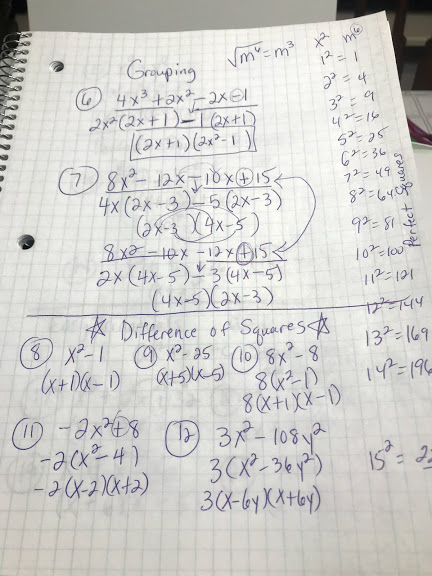
I start the factoring unit by teaching the students how to factor out a GCF. To help them understand, I’ll sometimes call it “undistributing”. Once they understand how to factor out a GCF, then I give the students grouping problems. They are taught to group the first two terms and the last two terms and then factor out a GCF. I tell them that if they get the same answer in both parenthesis then they have worked the problem correctly. They factor out the common parenthesis and make another parenthesis with the leftovers. Once they get good at this then I talk about differences of squares and perfect square trinomials.

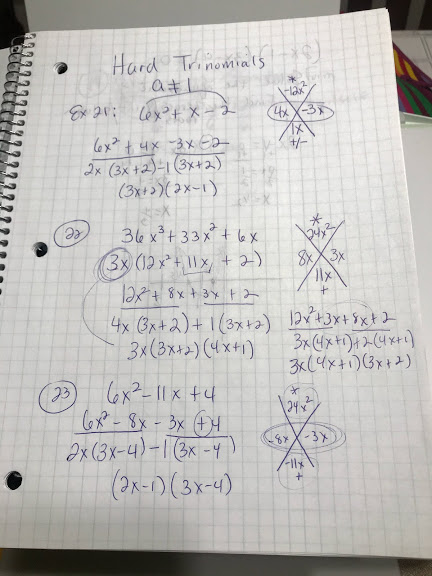
These are my notes from my Algebra 2 classes this year:

Next I teach them to spot easy trinomials and hard trinomials. I later explain that they are problems that either have an “a” equal to one or an “a” greater or less than one. I discuss how the signs work in trinomials:

  • + + = ( + )( + )
  • – + = ( – )( – )
  • – – = ( – )( + ) the larger number gets the –
  • + – = ( – )( + ) the larger number gets the +

When I teach the a = 1 problems, I tell the students to go to the last number and ask, “What multiplies to get the last number that will add or subtract to get the middle term.” Students can do this pretty well…especially if they know their multiplication facts.

When I teach the hard trinomials (a>1 or <1), I have the students draw a big X to the side of the problem. The students are directed to multiply the first term and the last term in the trinomial. They write that at the top of the X. The middle term goes at the bottom of the X. Next, they ask that same question about what multiplies to get the top number that adds or subtracts to get the bottom number. The students write it on the left and right side of the X. Now it’s time to turn the problem into a grouping problem. The students are told to write the first term of the original problem, then the two monomials they just found and the last term of the original problem goes on the end. Factor by grouping and they are done.

I know students should know this by the time they are in Algebra 2, but many of them don’t. I usually try to break these notes up into two days. I assign Games 1 – 6 of my Factoring Using Seek and Find. I love this activity because the students know if their answers are correct or not by finding the answers in the puzzle.

A quick tip on helping students that aren’t good with their multiplication facts. If they want to know for instance what multiplies to give you 300 that would subtract to get 44…Have students type 300/x into a graph of a graphing calculator, then go to the table. The table contains all the factors. I tell them to ignore all decimals. They will see a 50 and a 6 in the x and y columns. They can reason that if they subtract, they can get 44.

Factoring is a very important concept and students need this skill to survive in their upper level math courses. I finally feel confident that my students understand it since I now stick with a certain way of presenting it to them. I truly believe in the way I teach factoring and I hope that I have given you some ideas on how best to help your students successfully learn this concept!

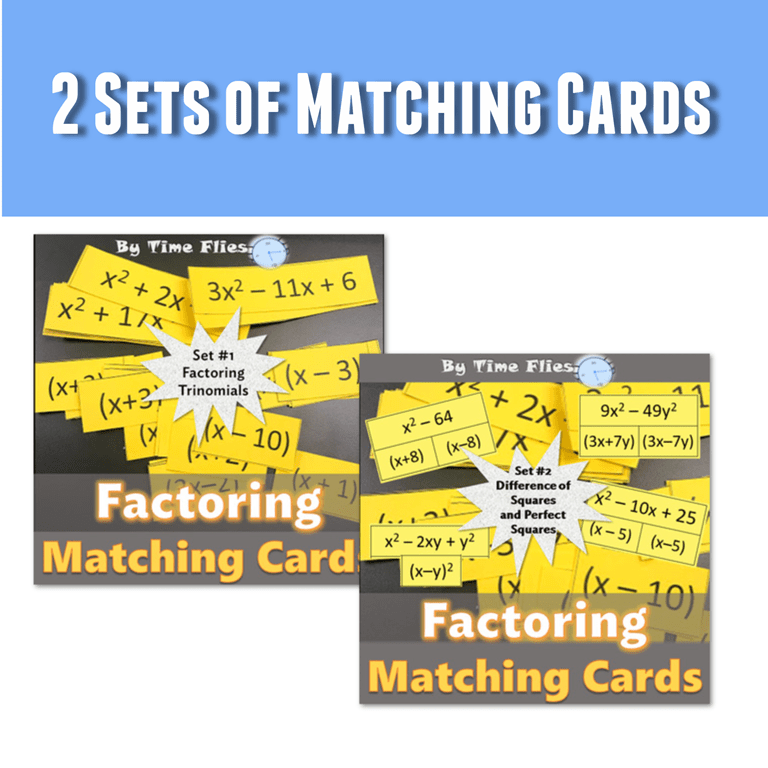
For my Algebra I classes, I made some factoring matching cards you might be interested in: Factoring Matching Cards #1 and Factoring Matching Cards #2.

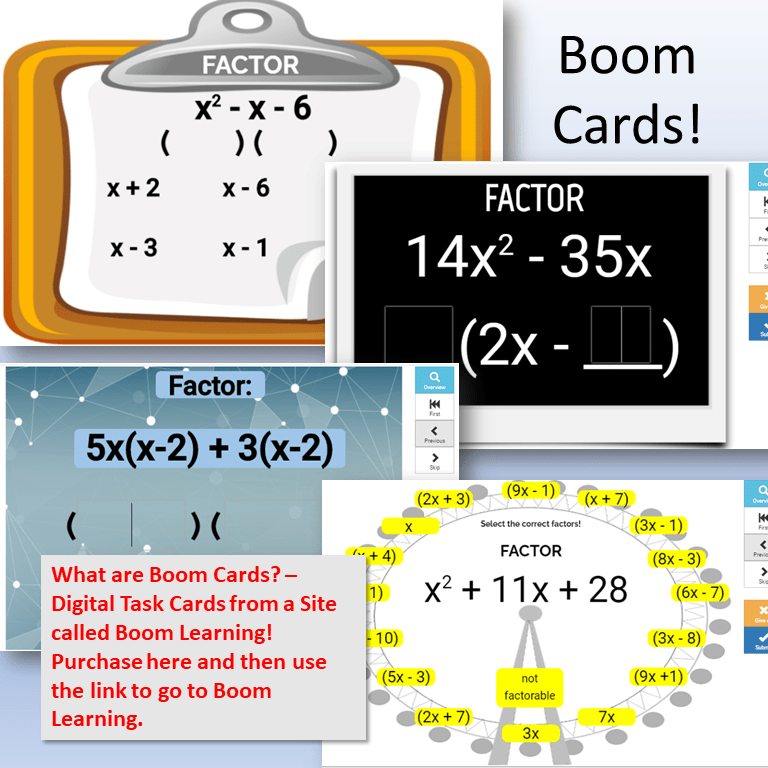
I also made 4 sets of Boom Cards. Boom Cards are awesome because you can have your students work through them as many times as they want until they understand. They are great for digital learning!

I finally have all of my factoring activities together in one bundle. You can never have too many factoring options. Factoring is a biggie and we all know how students tend to be weak in this area. The calculus teacher at my school is always telling me how students forget how to factor. This skill needs to constantly be recycled until it finally sticks!